
Please note
Reading this site, or contacting me through it, does not create a therapist and client relationship. Nothing here is clinical advice for your situation.
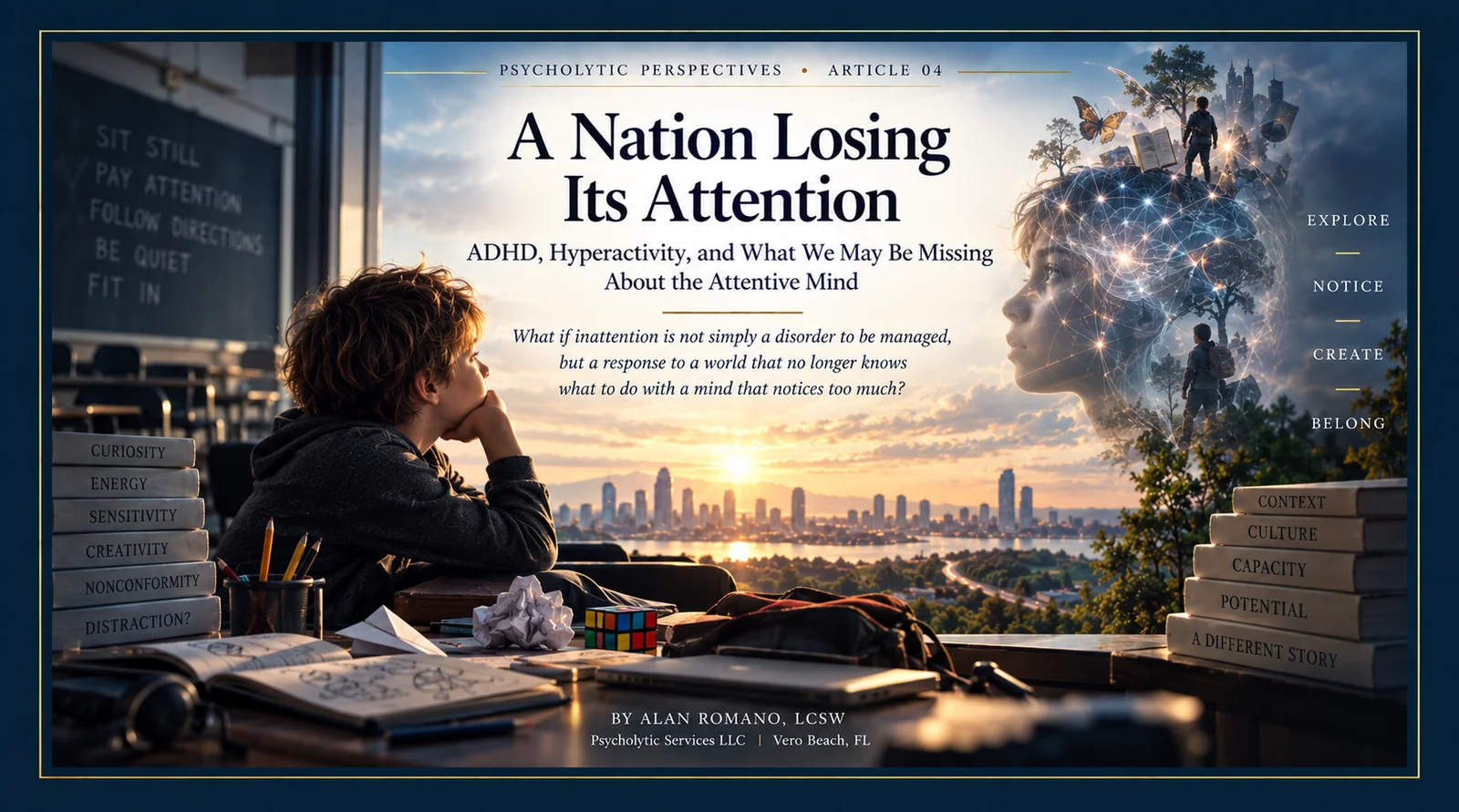
ADHD, Hyperactivity, and What We May Be Missing About the Attentive Mind
A nation losing its attention
We learned to name the child who could not pay attention. Somewhere along the way, we stopped asking what their attention had learned to respond to.
BY ALAN ROMANO, LCSW · Psycholytic Services LLC | Vero Beach, Florida
When Did Attention Become a Deficit?
Attention difficulties and hyperactivity can be profoundly impairing. They can disrupt school, work, relationships, and a person’s ability to function in everyday life. But recognizing the difficulty is different from explaining it.
A diagnosis such as ADHD gives us a name for a recognizable pattern of inattention, hyperactivity, and impulsivity. That name can be useful. It can guide treatment, provide access to support, and help someone understand experiences they may have struggled with for years. But a description of a pattern is not necessarily an explanation for why the pattern exists.
This distinction is easy to lose. Someone struggles to pay attention because they have ADHD, and we know they have ADHD because they struggle to pay attention. The diagnosis can begin functioning as the explanation for the same behaviors used to establish it.
What if we remained curious a little longer?
Instead of asking only whether attention is deficient, we might also ask where that attention goes, what captures it, what disrupts it, and what conditions make it easier or harder to direct.
Naming the pattern is important. But perhaps the more interesting question begins after we have named it: what is this attention responding to?
Before ADHD, There Was a Reaction
The way we have understood attention and hyperactivity has changed considerably over time. In the 1968 edition of the DSM, what we might now recognize as part of ADHD was described as the “Hyperkinetic Reaction of Childhood.”
The word reaction is worth lingering on.
It does not prove that clinicians in 1968 understood these behaviors as responses to trauma, environment, relationships, or any cause. We should be careful not to read our current ideas backward into an older diagnostic term. But the language does reveal something about how psychiatric thinking has changed.
A reaction implies something more than a trait existing inside a person. It invites the possibility of relationship between the behavior and something the person is responding to. Over time, the terminology changed. The reaction became a disorder, and diagnostic language increasingly emphasized the characteristics being identified within the individual.
Perhaps something was gained through that precision. But it is worth asking whether something was also lost when we stopped calling it a reaction.
An FSRT perspective: Behavior Is Information
FSRT begins with the assumption that behavior is organized, even when its organization is difficult to understand.
Inattention, restlessness, impulsivity, and the need for stimulation may create real impairment. But before treating the behavior only as something to suppress, we can also ask what conditions shape it, what changes it, and what the person’s system may be responding to.
Behavior can be a problem and still contain information.
Before ADHD, There Was Benzedrine
Long before ADHD or ADD existed as diagnoses, physicians were already observing something curious about stimulant medication.
In 1937, physician Charles Bradley reported that Benzedrine, an amphetamine, produced unexpected changes in some of the children under his care. Academic performance improved for some, and changes were also observed in behavior and emotional responses. This was decades before the diagnostic language of attention deficit emerged.
What is particularly interesting, however, is not simply that stimulants appeared to help.
Bradley was working within a broader therapeutic environment and did not evaluate children only by asking whether medication made them quieter or easier to manage. He considered school performance, social behavior, emotional responses, conflicts, environmental influences, and differences between individual children.
The medication was clearly part of what Bradley was observing, but he did not separate its effects from the larger life of the child.
That distinction is easy to overlook. Medication can change attention, behavior, or performance without explaining why those capacities were difficult to sustain in the first place. Bradley could observe that Benzedrine changed how some children functioned while continuing to observe the relationships, conflicts, environments, and individual differences surrounding those changes.
The response to the medication was information. It was not the whole explanation.
Nearly ninety years later, that distinction remains important. When a treatment changes attention, behavior, or performance, we have learned that something can change the pattern. But what, exactly, does that change allow us to conclude about the pattern itself?
What Did Improvement Actually Tell Us?
This brings us to a question that sits at the center of how we understand ADHD: what exactly does improvement tell us?
If a medication increases concentration, reduces movement, improves classroom performance, or helps someone organize their thoughts and behavior, those changes matter. For some people, they can be life changing. But we must be careful about what we conclude from the response.
A medication response tells us that the medication changed something. It does not independently tell us why the original pattern developed.
This distinction matters because treatment response can easily become explanation. If someone takes a stimulant and can suddenly concentrate, we may be tempted to see that improvement as confirmation that we have identified what was wrong in the first place. But changing a system is not the same as explaining how that system became organized.
The better question may not be simply, Did the treatment work?
It may be: What changed, what became possible because it changed, and what does that response allow us to conclude?
When a treatment changes a person, we have learned something about the treatment. We have not necessarily learned why their system organized the pattern that made treatment necessary in the first place.
From Reaction to Deficit
By 1980, the language had changed. DSM III replaced Hyperkinetic Reaction of Childhood with Attention Deficit Disorder, with or without hyperactivity. Attention, rather than hyperactivity alone, had moved closer to the center of the diagnosis.
The shift was more than a change in terminology. The word reaction disappeared and deficit took its place.
Again, the language itself does not tell us what caused the behavior, nor does changing diagnostic terminology prove that psychiatry stopped considering context. But words influence where we look. A reaction invites us to ask what someone might be reacting to. A deficit directs our attention toward what appears to be missing or impaired within the individual.
Both perspectives can reveal something important. The risk comes when one replaces the other.
Perhaps attention can be impaired without being meaningless. Perhaps something can function as a deficit while still having a history, an organization, and a reason for taking the form that it did.
An FSRT perspective: Deficit or Adaptation?
Calling a pattern adaptive does not mean it is healthy or without consequence. A system can organize in ways that once served a function and still create significant impairment in the present.
FSRT does not ask us to choose between deficit and adaptation. It asks whether what appears deficient might also tell us something about how the system learned to organize itself. Impairment tells us something is not working. It does not tell us why it became organized that way.
From ADD to ADHD
The language changed again in 1987, when ADD became Attention-Deficit/Hyperactivity Disorder. Over time, the diagnosis continued to become more refined, eventually distinguishing between predominantly inattentive, predominantly hyperactive-impulsive, and combined presentations.
There was value in this evolution. Greater diagnostic precision helped clinicians recognize that attention difficulties do not always look the same. A person does not need to be visibly restless or disruptive to struggle profoundly with attention, organization, impulse control, or executive functioning.
But increasing our ability to describe a pattern does not necessarily increase our understanding of how that pattern developed. The more precisely we identify what a person is doing, the easier it can become to believe we have also explained why.
The history of ADHD therefore leaves us with a question worth carrying forward:
What did we gain as the diagnosis became more precise, and what might we have stopped asking along the way?
When Did Movement Become Hyperactivity?
Children move. They fidget, climb, interrupt, wander, explore, become restless, and struggle to remain still. There is also enormous natural variation in how much movement different people need. Movement itself is not pathology.
Hyperactivity becomes clinically meaningful when activity is persistent, developmentally inappropriate, occurs across settings, and begins interfering with a person’s ability to function. That distinction matters. But it also raises another question: how much of what we call excessive movement exists in relationship to the environment asking someone to remain still?
A child who struggles through hours of sitting may function very differently while building something, playing outside, competing in a sport, or engaging deeply with something that captures their interest. That does not mean the environment caused ADHD, nor does functioning well in one setting erase impairment in another.
It means behavior changes in relationship to context.
Before deciding that someone moves too much, perhaps we should also ask what their environment requires them to do with their body, and whether their system can sustainably meet that demand.
The Child and the Chair
Consider what we ask of a child in school. Sit for extended periods. Direct your attention toward what someone else has decided is important. Move when the schedule permits. Transition when instructed. Delay impulses, regulate emotion, follow predetermined structures, and remain engaged even when your attention is being pulled somewhere else.
These expectations are necessary to some degree. Classrooms require structure, and children need opportunities to develop attention, patience, self-regulation, and the ability to participate with others. But the environment still matters.
The question is not whether classrooms cause ADHD. That would replace one overly simple explanation with another. The question is whether we can meaningfully evaluate a child’s ability to function without also evaluating the conditions in which we are asking that child to function.
A child and a chair do not exist independently of one another. When sitting becomes the expectation, difficulty sitting becomes clinically relevant. When sustained externally directed attention becomes necessary for success, difficulty directing attention becomes increasingly consequential.
Perhaps we should be evaluating both sides of that relationship: the capacities of the child and the demands of the environment requiring those capacities.
An FSRT perspective: Dysfunction Is Defined by the Living Field
A trait can create substantial impairment in one environment and become useful in another. The person has not necessarily changed. The Living Field has.
Clinical impairment does not exist outside of context and culture. What we define as dysfunction is shaped, in part, by the expectations of the world in which a person is being asked to function.
When the Same Trait Becomes a Strength
The characteristics associated with ADHD do not disappear when childhood ends. High activity, novelty seeking, rapid shifts in attention, spontaneity, intense engagement, and quick responsiveness can continue throughout adulthood.
In some environments, these traits create substantial difficulty. A person may struggle with repetitive work, rigid schedules, sustained administrative tasks, or environments requiring prolonged stillness and externally directed attention.
Place that same person in a different environment and the picture can change. Rapid responsiveness may become valuable. Novelty seeking can support exploration and creativity. High energy can sustain demanding work. Intense engagement can become an asset when attention connects with something meaningful.
This does not mean impairment is merely a matter of perspective. It means we should distinguish the trait itself from the consequences that emerge when that trait meets a particular environment.
Sometimes what changes is not the person, but whether the world around them has a use for the way they are organized.
The Same World, Different Adaptations
Two children can grow up in what appears from the outside to be the same environment and adapt to it very differently. One becomes watchful. Another moves constantly. One withdraws, while another becomes highly compliant, achievement oriented, or lost in imagination.
Human systems do not respond to circumstances according to a single formula. Temperament, biology, relationships, perception, developmental timing, and previous experience all influence how a person organizes around what they encounter.
This matters for ADHD because similar circumstances do not require identical adaptations, just as similar symptoms do not require identical origins.
Two children may both struggle to pay attention and arrive there through very different pathways. The symptom tells us what they have in common. Understanding the person requires us to ask where their paths diverged.
When Inattention Is Survival
Inattention tells us where attention is not. It does not necessarily tell us where it has gone.
A child who appears unable to attend to the teacher may be attending intensely somewhere else. Their attention may be tracking environmental threat, social dynamics, sensory information, internal experience, anticipated consequences, or changes in the emotional state of the people around them.
For some children, this may have been necessary. A nervous system that learned to monitor unpredictability, conflict, danger, or the emotional availability of others may become remarkably good at noticing signals that have little to do with what is being written on the board.
This does not explain every instance of inattention, nor does it explain ADHD as a whole. But the word deficit can obscure an important question by telling us what attention is failing to do without asking what it may have learned it needs to do.
Sometimes the attention that looks absent is already occupied with survival.
An FSRT perspective: Attention Is Being Organized
The system is not simply succeeding or failing at attention. Attention is continually being allocated according to biological capacity, learned priorities, environmental demands, perceived relevance, and regulatory need.
The Intelligence Inside the Symptom
FSRT begins with a different assumption: before we decide that a symptom represents dysfunction, we become curious about what the system may be trying to accomplish through it.
This does not mean every behavior is healthy, that every adaptation remains useful, or that suffering should be romanticized. A pattern can become profoundly limiting long after the conditions that shaped it have changed.
The point is simpler. We begin with function before defect.
Inattention, movement, impulsivity, novelty seeking, or intense shifts in focus may be creating real problems in the present. But rather than asking only how to make them stop, we can also ask how they became organized, what they may have helped regulate, and whether the system has developed another way to meet the same need.
Before we remove a symptom, we should understand what the system might be using it for.
An FSRT perspective: A Pattern Does Not Have to Be Healthy to Be Regulatory
A conditioned pattern may become rigid, unconscious, costly, and poorly matched to present circumstances while continuing to participate in the system's attempt to regulate itself.
When Survival Outlives the Threat
An adaptation does not necessarily disappear when the conditions that shaped it are gone. The adult may no longer need to scan the environment, escape internally, move constantly, or seek stimulation in the same way, yet the system may continue returning to those familiar patterns.
FSRT describes this through homeostatic patterning. Living systems tend to return to organizations they know how to sustain, even when those organizations are no longer well suited to the present.
This is where adaptation can become impairment. What once helped the system regulate may eventually interfere with the life the person is trying to live.
The environment can change long before the system learns that it no longer needs the adaptation.
When Diagnosis Becomes the Explanation
A diagnosis is a way of organizing a recognizable pattern of symptoms, traits, and impairment into a clinically useful category. In ADHD, many of those characteristics, such as distractibility, movement, impulsivity, novelty seeking, and shifts in attention, exist on a spectrum throughout the human population. The diagnosis emerges when a persistent pattern meets established criteria, is developmentally inappropriate, occurs across multiple settings, and interferes with functioning.
This is where the boundary between trait and disorder becomes important.
Two people may share many of the same traits while experiencing very different consequences. One may struggle profoundly in school, relationships, or work. Another may find environments, roles, and ways of living in which those same characteristics become manageable or even useful. We do not diagnose the trait alone. Diagnosis depends, in part, on whether the pattern interferes with functioning within the person's life.
This makes diagnosis inherently contextual. What counts as impairment is influenced by developmental expectations, environmental demands, and culture. A diagnosis can help us describe what is happening and determine when support is needed. It still cannot, by itself, tell us why this person became organized this particular way.
The diagnosis tells us where a pattern became dysfunctional. It does not necessarily tell us where the pattern came from.
Relief Is Not an Explanation
Stimulant medication can be profoundly helpful. For some people, treatment meaningfully improves core ADHD symptoms, everyday functioning, and quality of life. Those improvements are important and should not be minimized.
But treatment response and origin are different questions.
If a stimulant helps someone direct attention, regulate impulses, or participate more effectively in their life, we have learned something important about what helps that person function. We have not necessarily learned why those capacities became difficult to sustain in the first place.
This is an important distinction because effectiveness can easily be mistaken for explanation. A medication does not need to correct the original cause of a pattern in order to change it.
Medication may give a person greater capacity to regulate. Understanding why regulation became difficult requires us to remain curious about the person beyond their response to treatment.
Capacity or Compliance?
When a child takes medication and begins sitting longer, completing assignments, interrupting less, or functioning more successfully in the classroom, those changes can be genuinely beneficial. School may become easier. Conflict may decrease. The child may experience greater confidence and a sense of competence that was previously difficult to access.
But improvement should invite more questions, not fewer.
Is the child suffering less? Are relationships improving? Is learning becoming easier? Do they feel more capable of directing their own attention? Are they developing greater emotional regulation and flexibility? Is treatment expanding their ability to participate more fully in their own life?
Or have they primarily become better able to meet the expectations of the environment around them?
These outcomes can occur together, but they are not synonymous. A quieter child is not necessarily a more regulated child. Increased productivity does not automatically mean increased capacity. Behavioral change tells us what became visible on the outside. It does not necessarily tell us what changed within the system producing that behavior.
An FSRT perspective: Regulation Is Not the Same as Suppression
Reducing the visibility of a behavior does not necessarily tell us what happened to the regulatory need underneath it.
Regulation expands capacity and choice. Suppression may simply make the struggle less visible.
The Living Field of Attention
Attention does not occur inside an isolated brain. It occurs within a person who is continually interacting with a body, relationships, environment, culture, and history.
From an FSRT perspective, attention emerges within the Living Field. Physiology, development, attachment, sleep, stress, movement, sensory experience, technology, education, relationships, expectations, medication, meaning, and accumulated adaptations can all participate in how attention becomes organized.
The relative importance of these influences will differ enormously from one person to another. There is no single formula for explaining why someone struggles to direct or sustain attention.
This is why the diagnosis can only take us so far. To understand the attention, we must understand the field in which that attention has learned to function.
What Function Does the Symptom Serve?
Instead of beginning with Why can’t you pay attention? FSRT asks what the pattern may be doing.
Where does attention go? When does it become easier to direct, and when does it become harder? What changes across environments? What does movement make possible? What happens internally when stillness is required? What does stimulation regulate?
We might also ask what requires enormous effort that appears effortless for someone else, or what suddenly changes when interest, urgency, novelty, or meaning enters the picture.
These questions do not assume every symptom has a hidden psychological explanation. They simply keep us curious about function.
Before asking how to correct the attention, we might first ask what the current organization of attention is accomplishing for the person.
Beyond the Deficit
The goal is not to replace ADHD with another universal explanation. It is not to deny the diagnosis, minimize impairment, or argue against medication that may substantially improve someone’s life.
It is to resist allowing the diagnosis to become the end of our curiosity.
Attention can be impaired and still have a history. A behavior can create dysfunction and still serve a function. Medication can help change a pattern without fully explaining how that pattern became organized.
Perhaps moving beyond the deficit means holding all of these truths at once. We can recognize suffering, provide treatment, and support change while continuing to ask what the person’s system is responding to, what the pattern has been doing, and what might allow something more flexible to emerge.
The question then becomes larger than how we make someone pay attention differently. What would allow this person to have greater capacity and choice in how their attention is organized?
An FSRT perspective: Assume Intelligence Before Dysfunction
Before asking how to eliminate a pattern, understand how the system is organized around it. Before assuming deficit, investigate function. Before changing the individual, examine the Living Field.
When change is necessary, the goal is not simply to produce more acceptable behavior. It is to help the person develop greater awareness, flexibility, capacity, and choice in how attention is organized.
A question for reflection
When your attention leaves where you think it should be, where does it go, and what might it be doing for you there?
Therapy outcomes vary from person to person. No result is promised or guaranteed.
About the author
Alan Romano, LCSW
Alan Romano is a Florida Licensed Clinical Social Worker and the founder of Psycholytic Services LLC. His work integrates trauma-informed psychotherapy, somatic approaches, Internal Family Systems, ketamine-assisted psychotherapy, and Functional Systems Regulation Theory.
If you are the person this is about
If something in this article reflects what you have been experiencing, therapy can offer a place to understand the pattern with greater depth, safety, and compassion.
Psycholytic Services offers in person therapy in Vero Beach and secure virtual therapy throughout Florida.
References
- American Psychiatric Association. (1968). Diagnostic and statistical manual of mental disorders (2nd ed.). Author.
- American Psychiatric Association. (1980). Diagnostic and statistical manual of mental disorders (3rd ed.). Author.
- American Psychiatric Association. (1987). Diagnostic and statistical manual of mental disorders (3rd ed., rev.). Author.
- American Psychiatric Association. (2022). Diagnostic and statistical manual of mental disorders (5th ed., text rev.). American Psychiatric Association Publishing.
- Bellato, A., Perrott, N. J., Marzulli, L., Parlatini, V., Coghill, D., & Cortese, S. (2025). Systematic review and meta-analysis: Effects of pharmacological treatment for attention-deficit/hyperactivity disorder on quality of life. Journal of the American Academy of Child & Adolescent Psychiatry, 64(3), 346–361. https://doi.org/10.1016/j.jaac.2024.05.023
- Bradley, C. (1937). The behavior of children receiving Benzedrine. American Journal of Psychiatry, 94(3), 577–585. https://doi.org/10.1176/ajp.94.3.577
- Diener, T.-S. L., Jackson, M., Lee, M. A., Grové, C., & Nguyen, V. (2025). Cross-cultural disparities in teachers' reports of ADHD symptoms and behavior: A scoping review. Social Psychology of Education, 28, Article 135. https://doi.org/10.1007/s11218-025-10092-y
- Faraone, S. V., Banaschewski, T., Coghill, D., Zheng, Y., Biederman, J., Bellgrove, M. A., Newcorn, J. H., Gignac, M., Al Saud, N. M., Manor, I., Rohde, L. A., Yang, L., Cortese, S., Almagor, D., Stein, M. A., Albatti, T. H., Aljoudi, H. F., Alqahtani, M. M. J., Asherson, P., … Wang, Y. (2021). The World Federation of ADHD International Consensus Statement: 208 evidence-based conclusions about the disorder. Neuroscience & Biobehavioral Reviews, 128, 789–818. https://doi.org/10.1016/j.neubiorev.2021.01.022
- Lange, K. W., Reichl, S., Lange, K. M., Tucha, L., & Tucha, O. (2010). The history of attention deficit hyperactivity disorder. Attention Deficit and Hyperactivity Disorders, 2(4), 241–255. https://doi.org/10.1007/s12402-010-0045-8
- Rohde, L. A., Szobot, C., Polanczyk, G., Schmitz, M., Martins, S., & Tramontina, S. (2005). Attention-deficit/hyperactivity disorder in a diverse culture: Do research and clinical findings support the notion of a cultural construct for the disorder? Biological Psychiatry, 57(11), 1436–1441. https://doi.org/10.1016/j.biopsych.2005.01.042
- Strohl, M. P. (2011). Bradley's Benzedrine studies on children with behavioral disorders. The Yale Journal of Biology and Medicine, 84(1), 27–33.
- Wolraich, M. L., Hagan, J. F., Jr., Allan, C., Chan, E., Davison, D., Earls, M., Evans, S. W., Flinn, S. K., Froehlich, T., Frost, J., Holbrook, J. R., Lehmann, C. U., Lessin, H. R., Okechukwu, K., Pierce, K. L., Winner, J. D., & Zurhellen, W. (2019). Clinical practice guideline for the diagnosis, evaluation, and treatment of attention-deficit/hyperactivity disorder in children and adolescents. Pediatrics, 144(4), e20192528. https://doi.org/10.1542/peds.2019-2528
Psycholytic Perspectives
A new essay roughly every Monday. The PDF lands in your inbox the morning it goes up.