
Please note
Reading this site, or contacting me through it, does not create a therapist and client relationship. Nothing here is clinical advice for your situation.
A nation medicating its depression
We have spent decades asking whether antidepressants work. Perhaps we have spent too little time asking why so many people need them, and what it means when distress becomes widespread enough to require pharmacological regulation at the scale of an entire population.
One in Eight
By 2015 through 2018, approximately 13.2 percent of American adults reported using an antidepressant during the previous 30 days. Among women, the figure was 17.7 percent. Among adults age 60 and older, it reached 19 percent, and among women in that age group, nearly one in four reported antidepressant use.
These numbers deserve careful interpretation. Antidepressants are prescribed for conditions beyond depression, including anxiety disorders, chronic pain, and other clinical concerns. Their widespread use therefore cannot simply be interpreted as a measure of depression prevalence.
Still, the scale is remarkable.
Across many of the world’s developed nations, antidepressant use has risen dramatically. Data collected by the Organisation for Economic Co-operation and Development (OECD), which tracks health trends across dozens of countries, shows that average antidepressant consumption more than doubled between 2000 and 2019. The United States is part of this much larger pattern. Across modern societies, more people are turning to medication to help manage depression and emotional distress, raising a question that deserves as much attention as the medications themselves:
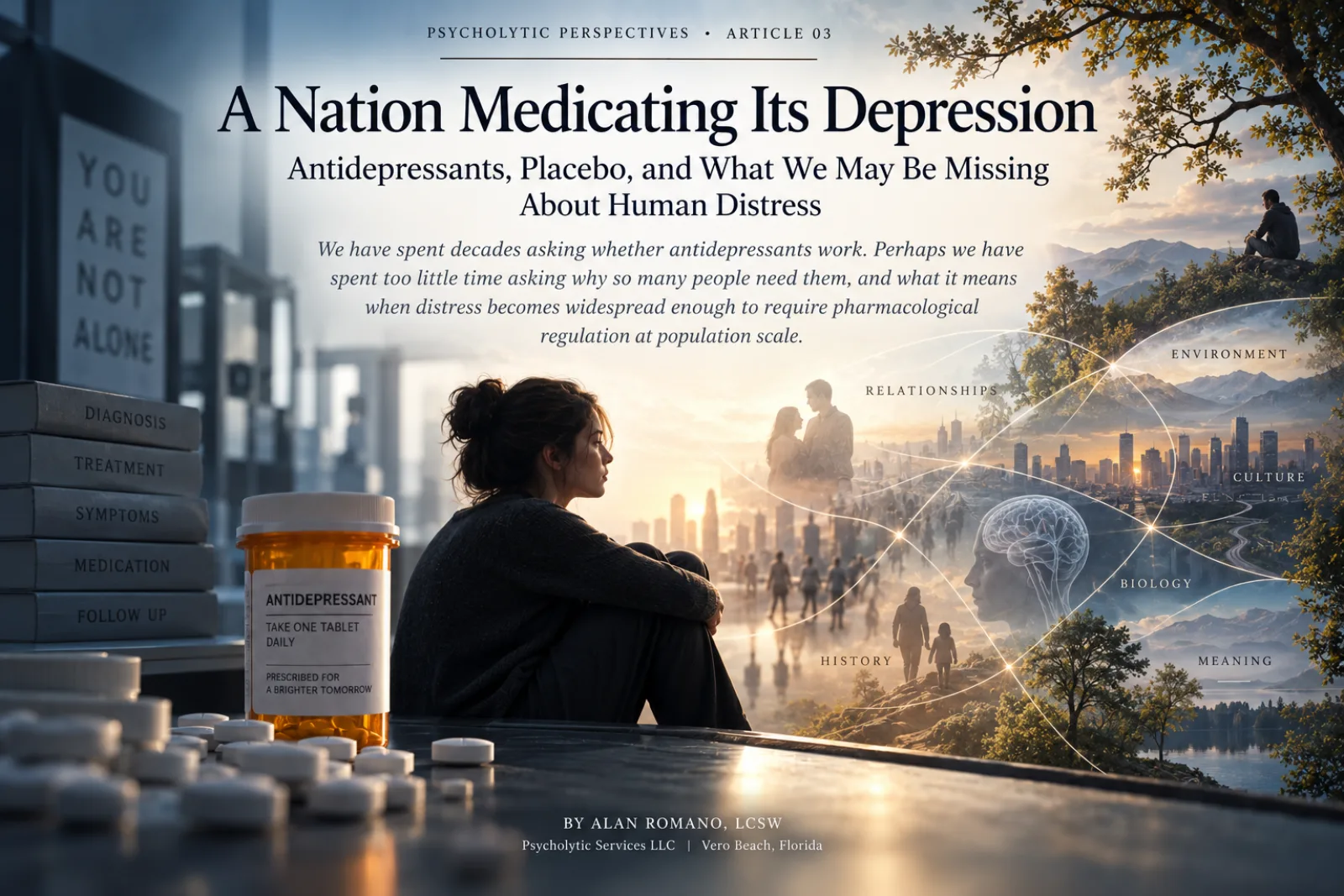
What has changed in the way we live that so many people now need help regulating how it feels to be alive?
The rise in antidepressant use can be understood in several ways. It may reflect greater recognition of depression, reduced stigma around seeking treatment, improved access to care, and the availability of medications that provide meaningful relief for many people. For generations, depression was often suffered privately, concealed from others, or interpreted as a weakness of character or will. The growing willingness to recognize depression as legitimate suffering and to offer treatment represents an important shift in how we respond to people in distress.
The concern is not that more people are receiving help, but whether treatment has expanded faster than our understanding of what so many people are struggling to endure.
But increasing access to treatment does not fully answer the question raised by the scale of its use. If growing numbers of people across developed societies require medication to help regulate mood, anxiety, sleep, motivation, or their capacity to participate in everyday life, then we should be willing to look beyond the prescription itself. We should ask what people are carrying, what their lives are requiring them to adapt to, and whether the expansion of treatment has been accompanied by an equally serious examination of the conditions producing so much distress.
Medication may help us respond to depression. Its widespread use may also be telling us something about the world in which depression is occurring.
An FSRT perspective: Widespread Distress Is Information
FSRT does not understand widespread emotional distress only as millions of isolated individual disorders. When depression, anxiety, exhaustion, and disconnection become increasingly common, we must also examine the Living Field in which they are emerging.
Medication may help an individual regulate and recover. But when the need for regulation expands across entire societies, the individual cannot remain our only level of analysis. A society can become increasingly effective at treating distress without ever asking why it has become so difficult to live within.
The Medication Revolution
The expansion of antidepressant treatment occurred alongside enormous changes in how depression was understood and treated. Medication offered something extraordinarily important by helping move depression away from being understood as a character defect, moral weakness, or failure of will and toward recognition as a legitimate form of human suffering deserving care. People who might otherwise have endured suffering privately gained access to treatment, and for some individuals, antidepressants have been profoundly beneficial, even lifesaving. That reality should not be minimized.
At the same time, the evidence that followed has complicated the story. After decades of antidepressant prescribing and hundreds of randomized clinical trials, the relationship between antidepressant medication, placebo, and depression has proven considerably more complex than the explanation many patients were once given. The question is no longer simply whether antidepressants work, but what their effects, limitations, variability, and relationship to placebo may reveal about the nature of depression itself.
What the Placebo Research Actually Found
In 2008, psychologist Irving Kirsch and his colleagues asked a deceptively simple question: how much of the improvement attributed to antidepressants could actually be separated from the improvement people experienced while taking a placebo? To investigate, they examined both published and previously unpublished clinical trial data submitted to the U.S. Food and Drug Administration, covering 35 trials and 5,133 participants. What they found complicated the familiar story. People receiving antidepressants improved, but so did people receiving placebo, and the difference between the two groups was relatively small. On average, that additional drug benefit fell below the threshold the researchers used to define a clinically meaningful difference. The exception appeared among people beginning treatment with the most severe levels of depression, where the difference became larger.
Two years later, a 2010 analysis by Fournier and colleagues examined individual patient data and found a similar pattern. The benefit of antidepressant medication over placebo appeared to grow as depression became more severe, while among people with mild to moderate depression the average difference was small and, in some groups, minimal. These findings did not demonstrate that antidepressants were simply placebos or that the improvement experienced by people taking them was unreal. They raised a more provocative question: if people receiving medication and people receiving an inactive pill can both experience substantial improvement, how much healing can truly be understood through the chemistry of the medication alone?
Later evidence further complicated the picture. In 2018, one of the largest analyses of antidepressant trials ever conducted examined 522 studies involving more than 116,000 participants and found that all 21 antidepressants studied were more effective than placebo for the short-term treatment of major depressive disorder. The average advantage was generally modest; however, substantial differences remained among medications and individuals.
Taken together, the research does not support the conclusion that antidepressants are simply placebos. It suggests something more complicated: antidepressants have a measurable effect beyond placebo on average, while substantial improvement also occurs among people receiving placebo.
Perhaps what antidepressant research reveals most clearly is that relief cannot be attributed to chemistry alone. Human suffering responds to chemistry, expectation, relationship, meaning and context, reminding us that depression was never occurring within an isolated individual to begin with.
Context is Part of the Treatment
The word placebo can create the impression that improvement occurring outside the specific pharmacological action of a medication is somehow imaginary or less real. But receiving a placebo in a clinical trial does not mean that nothing happened. The person entered a new environment shaped by assessment, attention, expectation, repeated contact, monitoring, treatment ritual, a coherent explanation for suffering, and the possibility that things might get better.
From an FSRT perspective, these are not inert variables surrounding the “real” treatment. They are part of the Living Field in which treatment occurs. Expectation, relationship, meaning, perceived safety, attention, and participation can influence how a living system organizes and regulates itself. If symptoms change when these conditions change, that response deserves to be understood rather than dismissed as merely placebo.
The question, then, extends beyond how much better an antidepressant performs than an inactive pill.
What we call the placebo response may be revealing something far more important: context itself can participate in changing how suffering is experienced and regulated.
The Chemical Imbalance That Wasn't So Simple
For decades, many patients encountered an appealingly simple explanation for depression: it resulted from a chemical imbalance, commonly described as too little serotonin, and antidepressants helped correct that imbalance. Contemporary evidence does not support depression being explained through such a simple causal model.
A 2022 systematic umbrella review led by psychiatrist Joanna Moncrieff examined several major areas of serotonin research and concluded that the available evidence does not support the idea that depression is caused by lowered serotonin activity or concentration.
This does not mean antidepressants cannot work. A medication does not need to correct the original cause of a condition to influence its symptoms, which means the validity of the serotonin deficiency explanation and the effectiveness of antidepressants are two separate scientific questions.
What the changing science does challenge is the assumption that depression can be adequately understood as a discrete chemical deficiency occurring inside an isolated brain. Depression appears to be far more heterogeneous, emerging through different pathways in different people. Biology matters, but so can sleep, chronic stress, trauma, grief, attachment, physical illness, economic insecurity, relationships, loneliness, meaning, environment, identity, and culture. More importantly, these influences rarely exist independently. They continually interact, shaping both the person and the conditions within which depression develops and persists.
Perhaps our inability to discover one isolated cause of depression is not simply a problem science has yet to solve.
Perhaps it is telling us something fundamental about the phenomenon we have been trying to explain: depression may never have been an isolated problem to begin with.
The failure of a single explanation for depression may not represent the failure of science. It may represent the failure of isolation as the level of analysis.
When Relief Becomes Another Burden
Any serious discussion of antidepressants must also acknowledge adverse effects. Depending on the medication and the individual, these can include sexual dysfunction, gastrointestinal symptoms, sleep disturbance, fatigue, weight changes, agitation, and other unwanted experiences. Some patients also report emotional blunting, describing a reduced capacity to experience not only sadness or distress, but pleasure, excitement, connection, and other positive emotions. For younger patients, suicidality requires particular attention, as research has identified an age dependent relationship between antidepressant treatment and suicidal thoughts or behaviors, contributing to warnings and recommendations for careful monitoring during treatment initiation and medication changes.
In my own clinical work, however, the concern is not limited to a list of individual side effects. I have repeatedly encountered a much longer and more complicated treatment story, one that clients themselves do not always recognize until we carefully reconstruct their history. This pattern often begins during adolescence or young adulthood, when a person begins struggling with depression, anxiety, trauma, instability, or some combination of distress. They seek help, receive a diagnosis, and begin medication. When improvement is incomplete, temporary, or accompanied by new difficulties, another medication may be added, followed by another. What began as a single intervention can gradually become a regimen involving several psychotropic medications, while the original conditions surrounding the person’s distress may receive far less sustained examination.
This is not the story of every person who takes psychiatric medication, nor should my clinical observations be mistaken for population level evidence. But among many of the people who arrive in my practice after years of antidepressant treatment, I hear a strikingly similar description. They do not necessarily tell me that they remain overwhelmingly sad. They tell me they feel flat. They struggle to cry, to experience joy, to feel deeply connected, or sometimes to identify what they are feeling at all. Some eventually describe the absence of feeling as more troubling than the painful emotions for which they originally sought treatment. They would rather feel sadness, anger, grief, or even depression than continue experiencing what they describe as emotional nothingness.
These accounts also resemble the phenomenon described in the literature as emotional blunting, although its relationship to depression itself, medication effects, and individual differences remain complex.
This is an important distinction. Reducing emotional intensity may sometimes be precisely what allows an overwhelmed person to regain stability and participate in life. But symptom reduction and healing are not automatically the same thing. If an intervention reduces unbearable sadness while also narrowing a person’s access to joy, grief, intimacy, desire, and emotional meaning, we should be willing to ask what has actually changed.
Has the person developed a greater capacity to experience and regulate emotion, or has the range of emotion requiring regulation simply become smaller?
These risks do not establish that antidepressants are broadly harmful. They reveal something more complicated and clinically important: treatment response is deeply heterogeneous. A medication that gives one person enough relief to reenter their life may become an additional regulatory burden for another. The responsibility of treatment is not simply to ask whether symptoms decreased, but to remain curious about what happened to the whole person after they did.
An FSRT perspective: A Diagnosis is Not a Cause
Two people can meet the same criteria for depression while arriving there through profoundly different biological, psychological, relational, developmental, cultural, and environmental pathways. The diagnosis may be the same. Their Living Fields are not.
A treatment that provides meaningful regulation for one person may do little for another or create additional burden. From an FSRT perspective, this variation is not simply noise. It may be information about the different forms of suffering we have placed beneath a single diagnostic name and how easily that name can lead us toward the same treatment for fundamentally different forms of suffering.
When Stopping Becomes its own Experience
Antidepressant withdrawal has also undergone an important reassessment. For years, discontinuation symptoms were frequently characterized as relatively mild and short lived. Contemporary guidance is more nuanced. Withdrawal can include dizziness, sensory disturbances, sleep disruption, anxiety, irritability, gastrointestinal symptoms, mood changes, and other physical and psychological experiences.
For some people, withdrawal symptoms are resolved relatively quickly. For others, they can be severe or prolonged. Current guidance from the National Institute for Health and Care Excellence (NICE) recommends gradual, individualized dose reduction and recognizes that withdrawal symptoms can sometimes persist for weeks or, in some cases, months. This is an important evolution in how antidepressant discontinuation is understood and managed.
The distinction becomes especially important because withdrawal can resemble the very condition for which the medication was originally prescribed. A person reduces or stops an antidepressant and begins experiencing anxiety, depression, insomnia, agitation, or emotional instability. It can then become difficult to determine whether the original condition is returning, the nervous system is responding to withdrawal, or some combination of both is occurring.
How that question is answered can profoundly influence what happens next, including whether the person continues tapering, returns to the medication, increases the dose, or begins another treatment altogether.
When the Patient Knew Before the System Did
Clinical knowledge changes, and that is not a failure of medicine. The willingness to revise what we believe when better evidence emerges is fundamental to science. But the evolving understanding of antidepressant withdrawal raises another important question: what happens when a patient’s lived experience does not fit the explanation available to the system treating them?
For years, some patients who experienced significant symptoms while reducing or discontinuing antidepressants were told that what they were experiencing represented the return of their depression or anxiety. Today, clinical guidance gives withdrawal considerably greater recognition and encourages clinicians to distinguish discontinuation symptoms from relapse. Science evolved, but many patients had already been describing the experience before the prevailing model had fully learned how to interpret it.
There is a larger lesson here that extends well beyond antidepressants. When a person changes following an intervention, the change itself is information. It should neither be automatically blamed on the medication nor automatically absorbed back into the diagnosis. Before deciding what a response means, we should first become curious about what changed, when it changed, what preceded it, and what the person’s living system may be responding to.
An FSRT perspective: Assume Intelligence Before Dysfunction
A living system’s response to an intervention is information. When symptoms emerge, disappear, or change following a medication change, the response deserves investigation before it is labeled dysfunction.
Assuming intelligence before dysfunction does not mean every symptom is beneficial. It means asking what the system is responding to before deciding what the response means.
The Data Changed. Did the System?
Contemporary mental health care has moved well beyond the simplest chemical imbalance explanation of depression. Modern guidelines recognize psychotherapy as an evidence-based treatment, acknowledge that people respond differently to medications, emphasize patient preference and shared decision making, and increasingly recognize the importance of carefully managed antidepressant discontinuation. Many clinicians also understand that depression rarely exists in isolation from the life in which it developed.
Yet clinicians practice within systems that may make this broader understanding difficult to translate into care. A practitioner may recognize that someone’s depression involves trauma, grief, isolation, relationships, chronic stress, disrupted sleep, physical health, economic insecurity, loss of meaning, or some combination of these influences. But understanding how those pieces came together requires something that modern systems often struggle to provide: time.
Medication can be prescribed during a relatively brief encounter. Understanding a person’s relationships, history, environment, losses, adaptations, and the patterns their system developed to survive them cannot. For someone seeking help, this is a vital distinction.
We have become increasingly quick to diagnose and begin treatment for depression without always understanding the life in which it developed. A prescription may change how a person feels, but it cannot tell us why their system is organized this way.
Perhaps, then, the challenge is larger than what clinicians have been taught or what treatments are available. It also involves the systems in which care is delivered and what those systems make possible. Understanding depression within the context of a person’s history, relationships, environment, losses, adaptations, and present circumstances requires time, curiosity, and sustained attention. If our science increasingly recognizes the complexity of depression, our systems of care must become capable of responding to that complexity. Otherwise, we risk expanding our ability to treat symptoms faster than our ability to understand the lives in which those symptoms developed.
A Nation Treating its Depression
By 2019, 15.8 percent of American adults reported taking prescription medication for their mental health during the previous year, compared with 9.5 percent who reported receiving counseling or therapy from a mental health professional. These figures cannot be read as a direct comparison between antidepressant use and psychotherapy for depression, since both categories include treatment for many different mental health concerns. Still, the difference raises an important question about how our system is structured to respond to emotional suffering.
Medication can be manufactured, distributed, prescribed, standardized, and reimbursed across enormous populations. Psychotherapy operates differently. It requires time, relationship, participation, trained practitioners, availability, and sustained human contact. This does not make medication less legitimate or psychotherapy inherently superior, but it does mean that the treatments most easily delivered at scale may become the treatments a healthcare system is most prepared to provide.
The widespread use of psychiatric medication may therefore tell us something beyond simply whether medication works. It may also reveal the architecture of the system delivering care, what that system can provide efficiently, and what forms of healing are more difficult to make widely available.
When pharmacological regulation becomes commonplace across a population, examining the medication alone is no longer enough.
When millions of people require pharmacological assistance to remain emotionally regulated, the medication deserves scientific examination. So do the conditions making regulation so difficult to sustain without it.
Depression Is Not One Thing
Antidepressants clearly provide meaningful relief for some people. For others, the improvement may be modest or temporary, while some experience little benefit or encounter adverse effects that create new difficulties. Medication may also serve different purposes at different points in a person’s life, providing stability or relief during periods when additional support is needed. Others find meaningful recovery through psychotherapy, relationships, changes in environment, improved physical health, community, purpose, or some combination of these approaches.
This variability should lead us toward a larger question about depression itself. What exactly have we placed beneath a single diagnostic name? Two people can meet the same criteria for depression while carrying entirely different histories, relationships, bodies, losses, environments, resources, capacities, and regulatory burdens. One may be living with unresolved trauma, another with profound isolation or grief, another with chronic illness or exhaustion, and another with vulnerabilities that are strongly biological. Most will carry some interaction among many of these influences.
If the pathways into depression can be profoundly different, perhaps we should not be surprised when the pathways out are different as well.
The variability in treatment response may not simply reflect the limitations of our treatments. It may be telling us something about the complexity of what we have chosen to call depression.
Beyond Symptom Reduction
If depression can emerge through profoundly different pathways, treatment must involve more than identifying which intervention reduces symptoms. For one person, biological vulnerability may carry substantial weight. For another, trauma, grief, isolation, exhaustion, chronic pain, relational distress, economic insecurity, loss of meaning, or some combination of these burdens may be central. Most often, these influences do not operate independently. They interact over time, shaping both the distress a person experiences and the ways their system has adapted to continue functioning within it.
Medication can alter an important part of this picture and, for some people, alter it profoundly. Psychotherapy can influence other dimensions. Changes in relationships, sleep, physical health, environment, community, purpose, safety, and daily life may change still others. The goal should not be to decide which of these represents the single correct treatment, but to understand how they participate together within the particular life of the person seeking help.
This changes the clinical question. Symptom reduction remains important, especially when suffering is severe, but reducing symptoms does not necessarily tell us what produced them, what continues to sustain them, or what will allow improvement to endure. Treatment becomes not only an effort to help someone feel better, but an inquiry into what would allow that person to develop greater capacity, connection, participation, and a more sustainable way of living.
An FSRT perspective: Treat the System, Not Just the Symptom
Depression does not occur in isolation. It emerges within the Living Field.
FSRT therefore asks more than what will reduce the symptoms. It asks: what is this system responding to? What is sustaining its current organization? What would allow it to reorganize toward greater capacity?
Treatment Without Reduction
None of this suggests that people taking antidepressants should stop them. Abrupt discontinuation can produce significant withdrawal symptoms, and decisions about reducing, changing, or discontinuing medication should be made carefully with an appropriately qualified prescribing professional. Nor should someone who has benefited from an antidepressant be told that their improvement was somehow less real because placebo responses exist or because the simple serotonin deficiency explanation has not held up. Relief is real, regardless of whether our explanation for it has changed.
The larger challenge is to resist allowing one useful intervention to become an entire explanation for human suffering. Depression deserves treatment, but it also deserves curiosity. A person experiencing depression may need medication, psychotherapy, safety, rest, relationship, medical investigation, changes in their environment, opportunities to grieve, greater connection to community, renewed purpose, or some combination that cannot be predicted from a diagnosis alone. The task is not to reject any one level of intervention, but to understand how each might participate within the life of this particular person.
Perhaps this is where our understanding of depression must continue to evolve. Healing does not begin by deciding in advance whether the answer is biological, psychological, relational, social, or environmental. It begins by becoming curious about the whole system in which suffering emerged, what that suffering may be responding to, and what would need to change for something more sustainable to become possible.
Sometimes the most important question is not simply how we make depression disappear, but what we might discover if we first ask what it has been trying to tell us.
A question for reflection
If your depression could communicate something beyond the need to make it disappear, what might it be asking you to recognize about yourself, your history, or the life surrounding you?
Therapy outcomes vary from person to person. No result is promised or guaranteed.
Designed and typeset by Alan Romano, LCSW.
About the author
Alan Romano, LCSW
Alan Romano is a Florida Licensed Clinical Social Worker and the founder of Psycholytic Services LLC. His work integrates trauma informed psychotherapy, somatic approaches, Internal Family Systems, ketamine assisted psychotherapy, and Functional Systems Regulation Theory.
If you are the person this is about
If something in this article reflects what you have been living with, that is the kind of work I do. Not deciding in advance what your distress means, but understanding the life it developed in.
You do not need to have read any of this before making contact. The clinical pages describe what the work actually looks like.
A note to readers
This article is not an argument for stopping antidepressant medication. Antidepressants can provide meaningful benefit, and abrupt discontinuation can produce significant withdrawal symptoms. Anyone considering reducing, changing, or discontinuing medication should discuss an individualized plan with an appropriately qualified prescribing professional.
Psycholytic Perspectives
A new essay roughly every Monday. The PDF lands in your inbox the morning it goes up.