
Please note
Reading this site, or contacting me through it, does not create a therapist and client relationship. Nothing here is clinical advice for your situation.
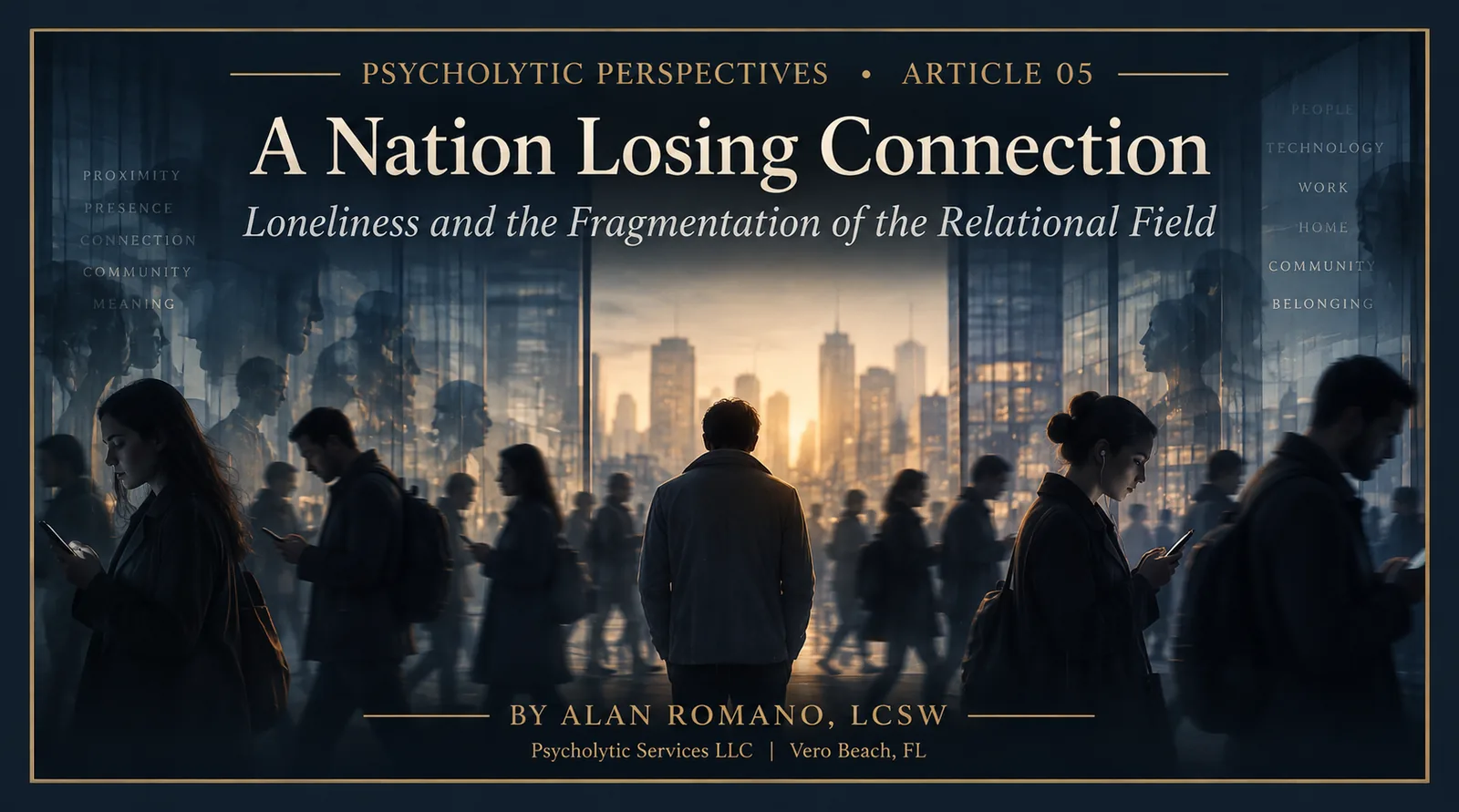
Loneliness and the Fragmentation of the Relational Field
What attachment, isolation, and the disruption of human connection may reveal about the relational nature of distress.
A nation losing connection
We learned to ask why people struggle to connect. Somewhere along the way, we stopped asking whether we were building a world in which connection could survive.
BY ALAN ROMANO, LCSW · Psycholytic Services LLC | Vero Beach, Florida
A Nation Surrounded and Alone
We have never had more ways to reach one another. A message can cross the world in seconds. Families separated by thousands of miles can see one another from their living rooms. Friendships can continue across cities and continents. Workplaces can exist without offices, communities can form without geography, and at almost any moment of the day we can reach into our pockets and find some form of human contact waiting for us.
With almost every technological measure, we should be more connected than any generation before us. Yet something about that connection appears increasingly difficult to sustain. Loneliness and social isolation have become significant public health concerns, with the U.S. Surgeon General identifying their consequences for individual health, community well-being, and the broader social conditions through which human connection develops (U.S. Department of Health and Human Services, Office of the Surgeon General, 2023). People can spend much of their day communicating and still feel profoundly alone. We can know what hundreds of people are doing, where they traveled, what they ate, what they celebrated, and what they believe, while having remarkably few people who truly know what is happening inside our own lives.
It is tempting to explain this contradiction by pointing toward the most visible changes around us. Smartphones have altered how we spend our attention. Social media has transformed friendship, comparison, and belonging. Dating apps have changed how people meet. Remote work has changed where relationships form. Streaming, delivery services, online shopping, and digital entertainment have made it possible to satisfy more of our needs without ever leaving home. Yet none of these changes alone can explain what happened.
Something larger has been changing in the architecture of everyday life.
Relationships do not emerge simply because people want them. They require conditions in which they can develop. Friendship requires repeated encounters. Intimacy requires time. Trust requires enough experience with another person to discover whether vulnerability can survive. Community requires places where people continue encountering one another, often before they have decided whether they particularly want to. For much of human life, these conditions were embedded into the ordinary structures of family, neighborhood, school, work, religion, recreation, and public life. They were imperfect structures, sometimes deeply so, but they repeatedly placed human beings in relationship with one another.
Many of those structures have changed. Families are often spread across greater distances. Work can be done from a bedroom or kitchen table. Food can arrive at the door. Entertainment has moved into the home. Shopping, banking, education, healthcare, and countless other activities can increasingly occur without physical contact with another person. None of this is inherently harmful. Much of it has made life more accessible, efficient, and flexible. But convenience can change more than the task it makes easier. It can also remove the encounters that once surrounded that task.
Perhaps that is part of what makes modern loneliness so difficult to understand. We experience it privately, but many of the conditions shaping it are not private at all. The person who struggles to make friends may certainly carry an attachment history, social anxiety, fear of vulnerability, or patterns of avoidance worth understanding. But they are also trying to form relationships within a particular moment in history, inside environments that determine how often people meet, how long they remain together, what they depend upon one another for, and how easily they can retreat when connection becomes uncomfortable.
Loneliness is experienced by the individual, but the conditions that make belonging possible are built between us.
When Loneliness Became Personal
Loneliness is one of the most personal forms of suffering. It is felt privately, carried internally, and often interpreted as evidence that something about us has failed. We begin looking inward for an explanation. Perhaps we are too anxious, too guarded, too difficult to know, or too afraid of rejection. In therapy, that search may lead into attachment, self-esteem, vulnerability, avoidance, communication, depression, or the relational experiences that shaped what we came to expect from other people.
There is a great deal to discover there. Our histories shape how we approach relationships, what we expect from them, how much of ourselves we are willing to reveal, and how quickly we retreat when connection begins to feel uncertain. But understanding the person can only take us so far. Loneliness presents a peculiar problem because the experience belongs to the individual while the thing they are longing for does not.
Unlike anxiety, sadness, or even pain, loneliness contains another person within its meaning. The need to form and maintain meaningful interpersonal attachments has long been recognized as a fundamental human motivation, suggesting that belonging is not simply an individual preference but a central dimension of psychological life (Baumeister & Leary, 1995). We can experience loneliness alone, but we cannot resolve the absence of meaningful connection entirely through individual effort. No amount of insight can manufacture reciprocity. Self-reflection cannot create someone who notices when we are absent. Emotional regulation cannot substitute for being known. A person can become more capable of intimacy, more willing to risk vulnerability, and more aware of the patterns that keep others at a distance, but belonging still requires a world in which there are people and places to belong to.
An FSRT perspective: Regulation Is Relational
Human regulation does not occur in isolation. We develop, organize, and regulate within relationships. The presence, absence, safety, and responsiveness of others can change what a system is capable of sustaining.
Connection is not simply something the system desires. It is part of the field through which the system regulates.
The Architecture of Belonging
Belonging does not emerge from intention alone. We may want friendship, intimacy, community, and meaningful relationships, but wanting connection does not create the conditions through which connection develops. Relationships need somewhere to happen. They need time, repetition, proximity, shared experience, and enough continuity for unfamiliar people to gradually become familiar to one another.
Much of this happens through structures so ordinary that we rarely recognize their role. Neighborhoods place people in proximity to one another. Schools have brought children together repeatedly over years. Extended families create relationships that stretch across generations. Religious communities, clubs, recreational groups, local businesses, parks, libraries, and public spaces create the familiarity that comes from sharing places, routines, experiences, and time. Research on everyday social interactions suggests that even relatively weak social ties can contribute to subjective well-being, offering evidence that meaningful social experience extends beyond intimate relationships and close friendships (Sandstrom & Dunn, 2014b). Belonging develops through this accumulation, as unfamiliar people gradually become familiar, and familiar people are given the opportunity to become something more.
Workplaces have historically provided another structure for connection, bringing people together through shared responsibilities, challenges, and routines. Yet there is a peculiar contradiction in environments where adults may spend more waking hours with coworkers than with their own families while remaining largely unknown to the people beside them. We can collaborate through difficult situations, share daily frustrations, celebrate professional accomplishments, and spend years working alongside someone without knowing much about their life beyond the workplace. Some of this distance is maintained through formal boundaries involving professional relationships, workplace hierarchies, and conflicts of interest. Other boundaries are less visible, shaped by an unspoken expectation that personal struggles should remain private and emotional vulnerability should not interfere with professionalism. These boundaries can serve legitimate purposes, particularly where differences in power exist. But they also raise an uncomfortable question: What does it mean when the places where we spend so much of our lives bring us into constant contact with other people while offering so little space to become genuinely known?
The answer may lie partly in what happens within those encounters. Proximity creates opportunities for relationships, but it does not determine whether they deepen. Someone remembers what we shared the week before. A conversation continues beyond its original purpose. A moment of vulnerability is met with understanding rather than discomfort. Over time, these experiences can create the trust and familiarity through which people begin to matter to one another beyond the roles they occupy. Belonging rarely emerges from a single encounter. It develops through continuity, reciprocity, and the gradual experience of being recognized.
Yet many features of modern life have altered the continuity through which these relationships develop, often while offering something valuable in return. Greater mobility has expanded where people can live and work. Remote work has created flexibility for families and made employment accessible across distance. Technology allows relationships to survive separation and gives people access to communities they may never have found locally. The story is not simply that modern life has made us less connected, nor that some earlier version of society offered a better way of life.
What has changed is how much of daily life can now be organized without sustained dependence on the people around us. We can move to a new city without knowing our neighbors, work alongside people we rarely meet in person, order what we need without entering a store, entertain ourselves without leaving home, and maintain relationships across enormous distances while having relatively little contact with the people living closest to us. Increasingly, participation in the physical communities around us is something we can choose rather than something ordinary life continually requires.
This creates a different problem than simply having fewer social interactions. When the places, routines, and shared responsibilities that repeatedly bring people together begin to disappear, relationships lose some of the conditions through which they once had time to develop. The desire for friendship, intimacy, and belonging may remain unchanged, while the pathways through which strangers become familiar, and familiar people become significant to one another, grow less certain.
Belonging requires architecture.
The architecture surrounding human connection had already been changing for decades. Families became more geographically dispersed, communication increasingly moved through technology, work became more mobile, and everyday life became easier to organize around the individual. These changes accumulated gradually enough that they could become part of ordinary life without always being recognized as changes to the relational environment itself.
Then, within a matter of weeks, much of that environment changed at once.
When the Living Field Changed Overnight
In early 2020, many of the structures through which people encountered one another suddenly disappeared. Schools closed their doors. College campuses emptied. Offices moved into homes. Restaurants, gyms, churches, clubs, playgrounds, and gathering places went quiet. Weddings were postponed, funerals were restricted, families stopped visiting, and ordinary physical proximity became something people were asked to approach with caution. For a period, one of the primary ways we were told to care for one another was by staying away from one another.
The disruption reached far beyond the loss of social activity. Daily routines changed, roles changed, relationships changed, and many of the environments through which people understood themselves changed with them. A student was still a student, but the classroom was gone. A coworker remained a coworker, but the workplace had disappeared. Grandparents were still grandparents, friends were still friends, and communities technically remained intact, but many of the places and rituals through which those relationships had been lived were suddenly unavailable.
The event was shared, but the experience of it was not.
Research examining the early pandemic identified significant concerns about the relationship between social isolation, loneliness, and the mental health of children and adolescents, particularly as disruptions to ordinary social experiences altered opportunities for connection during important developmental periods (Loades et al., 2020).
Consider what those years interrupted at different points in development. A child entering adolescence lost access to peers during a period when relationships outside the family were becoming increasingly important. A student beginning high school entered a new developmental world through a screen. A senior preparing to graduate lost ceremonies, final seasons, familiar hallways, and many of the ordinary endings that mark the transition out of childhood. A young adult preparing to leave home for college may have instead remained in the bedroom they were preparing to leave. Someone graduating from college and expecting to begin a career entered a labor market transformed by uncertainty and remote work. New parents navigated early parenthood with less access to family and community. Older adults could find themselves physically separated from the relationships that had organized much of their daily lives.
To describe all these experiences simply as isolation would miss something. People were not only separated from one another. Expected transitions were interrupted. A subsequent systematic review of adolescent peer relationships during COVID-19 documented the varied effects of pandemic-related disruptions on young people's social experiences, reinforcing the importance of considering developmental context rather than treating isolation as a uniform experience (Magis-Weinberg et al., 2025). Developmental milestones that ordinarily unfold within relationships and communities were altered, delayed, compressed, or experienced without many of the people who would normally witness them. The same historical event entered millions of lives at entirely different moments, and what was disrupted depended partly on what each person had been preparing to become.
We did not simply lose contact with one another. We lost the places, rituals, and relationships through which parts of ourselves were becoming possible.
Two people could therefore live through the same months, under similar restrictions, and emerge with very different experiences. For one person, staying home offered relief from an exhausting social world. For another, it removed the relationships that had helped keep them regulated. One family became closer through increased time together, while another found conflict impossible to escape. Someone with an established partner, stable home, and close relationships encountered a very different relational environment than someone who had just moved to a new city, was living alone, or was only beginning to build an adult social world.
Understanding those differences requires more than asking what happened. We also have to ask what system the event happened within. Developmental stage, relationships, family structure, economic stability, physical environment, existing patterns of regulation, access to community, and the meaning attached to what was being lost all participated in how the disruption was experienced.
COVID offers an unusually visible example of something that is ordinarily much harder to see. Human beings do not develop independently and then enter an environment. Development continually occurs within an environment, through relationships, routines, expectations, roles, and shared experiences. Change enough of those conditions at once, and the person does not simply remain unchanged inside a different world. The system begins reorganizing around the world that is now available to it.
Eventually, the world began to reopen.
Schools resumed. Offices brought people back or settled into hybrid arrangements. Restaurants filled again. Travel returned. Weddings happened. Stadiums reopened. Families gathered. The external conditions changed once more.
But restoring the environment does not necessarily restore the system that adapted to its absence.
When the World Reopened, but the Pattern Remained
When restrictions began to lift, there was an understandable expectation that life would resume. Schools reopened, workplaces welcomed people back, families gathered, and public spaces became available again. Yet restoring the physical structures of everyday life did not mean that people would simply return to the ways they had lived before. The circumstances had changed, but so had the people who had adapted to them.
During months and years of disruption, individuals and families developed new routines, expectations, and ways of regulating themselves. Some became accustomed to smaller social circles, more time alone, or relationships maintained primarily through screens. Others reorganized their lives around the household, discovering new rhythms of work, family, and personal responsibility. What began as a response to extraordinary circumstances gradually became familiar, and familiarity can influence what a person experiences as manageable, predictable, or sustainable.
An FSRT perspective: Homeostatic Patterning
Systems do not necessarily return to an earlier way of functioning simply because the conditions that produced an adaptation have changed.
Within FSRT, Homeostatic Patterning describes the tendency of systems to organize around patterns they have developed the capacity to sustain. When conditions change, those patterns may persist even after the circumstances that helped produce them are gone.
The world can reopen before the system reorganizes.
For some people, returning to previously familiar environments required another period of adjustment. A crowded classroom could feel overwhelming after prolonged separation from peers. A commute that once seemed ordinary might now feel exhausting. Entering a room full of strangers could require more emotional effort than it once had. Relationships previously sustained through repeated proximity now demanded greater intention. The return of an opportunity did not necessarily restore the ease with which someone could participate in it.
Not every change represented dysfunction. Some individuals discovered that quieter lives suited them better. Families developed routines they wanted to preserve, and greater flexibility created opportunities for people whose previous circumstances had been restrictive or exhausting. Adaptation can reveal possibilities as readily as it can create limitations. The question is not whether people returned to precisely the lives they had before, but whether their emerging patterns continued supporting the relationships, capacities, and experiences they valued.
For others, however, patterns that had made an extraordinary period manageable began limiting participation in a world that had become available again. Social withdrawal could remain familiar even when connection was desired. Avoiding uncomfortable situations could provide immediate relief while making reengagement increasingly difficult. The person might recognize what they were missing without finding it easy to return.
Within FSRT, this illustrates the difference between a change in external conditions and a change in the system's organization. The availability of new possibilities does not automatically create the capacity to sustain them. Reorganization may require repeated experiences through which unfamiliar forms of participation gradually become manageable and meaningful.
What happens when an adaptation developed during extraordinary circumstances becomes easier to sustain than the life a person now wants to live?
The Convenience of Disconnection
Modern life has made it possible to accomplish an extraordinary number of everyday tasks with fewer demands for direct human interaction. Technology has expanded access, reduced unnecessary effort, and allowed people to maintain relationships across distances that once made regular communication difficult. These developments have brought genuine benefits. Yet they have also changed something less visible: how frequently ordinary life requires us to encounter one another.
Consider the small interactions that once surrounded everyday responsibilities. The cashier who recognized us. The neighbor we passed outside. The coworker we spoke with while getting coffee. The parents we encountered at school pickup. The familiar faces at the gym, library, restaurant, or neighborhood store. Most of these encounters never developed into close friendships, but they created something between anonymity and intimacy: familiarity.
These interactions may appear insignificant when considered individually. Yet research suggests that even minimal social interactions can contribute to feelings of belonging and positive affect, indicating that the psychological value of everyday encounters may extend beyond their immediate practical purpose (Sandstrom & Dunn, 2014a). Repeated encounters can also create opportunities for recognition, conversation, trust, and eventually deeper relationships. Someone remembers our name. A brief exchange becomes a longer conversation. A familiar face becomes someone we look forward to seeing. Relationships often develop not because people deliberately set out to create them, but because the structure of everyday life allows encounters to accumulate.
What happens when a society systematically removes the small inconveniences that once required us to encounter one another?
Some of what we once considered inconvenience also created opportunities for relational participation. Waiting in line, sharing public spaces, and interacting with unfamiliar people required us to tolerate small uncertainties, negotiate differences, communicate, and occasionally allow ourselves to be seen. These encounters did not guarantee meaningful connection, and they were not equally comfortable or accessible for everyone. Nevertheless, they created possibilities for human contact that did not depend entirely on individual initiative. Even brief exchanges with familiar faces could contribute to a sense of recognition and belonging, reminding us that not every meaningful connection needs to develop into a close friendship.
When those encounters become optional, the responsibility for creating connection can shift increasingly onto the individual. Someone who wants friendship may have fewer spontaneous opportunities to develop it. A person experiencing social anxiety may find it easier to avoid uncomfortable interactions, even while longing for greater connection. Someone exhausted by work and family responsibilities may repeatedly choose the immediate relief of remaining home. Each decision may be understandable, even beneficial in the moment, while the cumulative effect can leave fewer opportunities for relationships to develop.
An FSRT perspective: Relief Is Not Reorganization
Reducing an uncomfortable social encounter may regulate distress in the moment. But removing the demand does not necessarily increase the system's capacity to meet it.
When the environment continually accommodates withdrawal, relief can become easier to sustain than connection.
This creates a paradox within contemporary life. We have developed extraordinary tools for maintaining contact while making sustained participation in the relational world around us less necessary. The capacity to communicate has expanded, but the ordinary circumstances through which people become familiar, recognized, and eventually known may be less consistently present.
The problem is not that convenience is inherently harmful, nor that every interaction needs to become meaningful. It is that belonging depends on opportunities that individual desire cannot create by itself. A person may want connection, possess the emotional capacity to participate in it, and still live within environments that provide few opportunities for relationships to deepen.
We can reach almost anyone, almost anywhere, at almost any time.
And increasingly, we can organize our lives without having to reach anyone at all.
When Disconnection Becomes a Symptom
The consequences of social disconnection are not confined to subjective experiences of loneliness. A large meta-analysis found that stronger social relationships were associated with greater likelihood of survival, demonstrating that the significance of human connection extends into physical health and longevity (Holt-Lunstad et al., 2010). Eventually, the consequences of disconnection may also become visible in the psychological experiences people bring into treatment. They may appear as anxiety, depressed mood, sleep disturbance, substance use, avoidance, loss of motivation, or a growing sense that life has become strangely empty. By the time someone enters a therapist's office, these experiences are often carried by one person, described through that person's symptoms, and understood through the language available for explaining individual distress.
That language can be useful. Depression is real. Anxiety is real. Substance use can become destructive. Avoidance can narrow a person's life until the very experiences they long for feel increasingly difficult to approach. Understanding these patterns can help people suffer less.
But there is another question worth asking: What if some of what appears to be happening inside the person is also happening between the person and the world around them?
A person may describe feeling depressed while spending most of their days alone. Someone may report social anxiety after years with few opportunities to practice being socially uncomfortable. Another may believe they have become incapable of intimacy after repeatedly experiencing relationships through environments where people can disappear from one another with little consequence. Someone may spend hours in therapy learning to regulate emotions and still return home to a life in which almost no one knows them deeply.
None of this means that loneliness explains depression, anxiety, addiction, or other forms of psychological suffering. Nor does it mean that individual treatment is misplaced. It means that symptoms can be real without the individual being the only level at which those symptoms can be understood.
An individual can participate in therapy alone. They cannot belong alone.
Psychotherapy can help someone recognize patterns, tolerate vulnerability, communicate more directly, repair attachment wounds, and develop greater capacity for relationships. But therapy cannot manufacture friendship outside the therapy room. It cannot create a neighborhood, restore a fractured family, provide someone with community, or guarantee that vulnerability will be met with reciprocity.
At some point, healing has to encounter another person.
What Healing Cannot Do Alone
If disconnection can contribute to suffering, then healing cannot be understood entirely as something that happens within the individual. There are changes we can make alone. We can develop insight, learn to regulate emotion, recognize patterns, reconsider beliefs, and become more capable of tolerating what once overwhelmed us. These capacities can profoundly change how we move through the world.
But some forms of healing require something beyond individual capacity.
Trust cannot be rebuilt without eventually risking trust. Intimacy cannot develop without allowing ourselves to be known. Relational wounds cannot be fully reorganized through understanding alone when what was missing was safety, responsiveness, repair, or recognition from another person. We may prepare ourselves for those experiences individually, but at some point, another person must enter the process.
This is part of what makes relationships so difficult and so necessary. Other people are not controllable environments. They disappoint us, misunderstand us, fail to respond as we hoped, and bring their own histories and defenses into the relationship. The vulnerability required for connection therefore carries genuine risk. Yet it is precisely within that uncertainty that capacities such as trust, repair, reciprocity, and intimacy become possible.
Psychotherapy offers one place where some of this can occur. A therapeutic relationship can provide consistency, witnessing, emotional safety, and opportunities to experience vulnerability differently. But the purpose cannot simply be to create a person who becomes increasingly capable of functioning within the therapy room. Greater capacity eventually has to become participation in life.
A person may become better able to tolerate vulnerability, but they still need someone with whom vulnerability can be practiced. They may learn to communicate their needs, but they need relationships capable of receiving those needs. They may become more capable of connection while continuing to live within a family, workplace, neighborhood, or culture that provides very little opportunity for meaningful belonging.
Healing, then, is not only about changing what happens inside us. Sometimes it requires changing how we participate in the relationships and environments around us. Sometimes it requires repairing an existing relationship. Sometimes it means risking a new one. Sometimes it means returning to community, allowing ourselves to become responsible to other people, or building structures of belonging that did not previously exist.
Within FSRT, this is where integration becomes reorganization. Insight becomes consequential when it changes how the system organizes itself within the Living Field. Greater regulatory capacity allows new patterns of thought, emotion, relationship, and behavior to become increasingly sustainable. We become better able to remain present where we once withdrew, tolerate uncertainty where we once sought immediate relief, repair rather than disappear, and respond in ways that are no longer governed by the patterns the system once needed to maintain.
Perhaps the measure of healing is not simply how well we can regulate ourselves when we are alone, but what becomes possible between us when we are together.
When Loneliness Is Telling the Truth
There is a particular kind of suffering that emerges when loneliness becomes something we believe we should have overcome. We begin to experience it not simply as an absence of connection, but as evidence of personal inadequacy. We should have more friends. We should be better at maintaining relationships. We should be comfortable alone, more emotionally independent, less affected by the presence or absence of other people. Somewhere within these expectations, the desire to belong can become another reason to question what is wrong with us.
But what if loneliness is not always telling us that something within us has failed?
What if, at times, it is telling us something about the conditions in which we are trying to live?
Hunger does not necessarily indicate that something is wrong with the body for needing nourishment. Exhaustion does not necessarily indicate that something is wrong with a person for needing rest. Both can be meaningful responses to conditions that are not adequately meeting the needs of the organism. Loneliness may sometimes deserve similar consideration. If the need to belong is a fundamental human motivation, as Baumeister and Leary (1995) proposed, then the discomfort of disconnection may be more than an unwanted emotional state. It may reflect the absence of relationships, reciprocity, recognition, or participation that human beings need in order to flourish.
This does not mean that loneliness is always an accurate reflection of our external circumstances, or that our personal histories have no role in its development. Attachment experiences, fear of rejection, relational defenses, expectations, and patterns of avoidance can profoundly influence how we approach connection. Some of us withdraw before others have the opportunity to know us. Some protect ourselves from rejection so effectively that intimacy becomes nearly impossible. Others remain surrounded by people while concealing the very parts of themselves they most want another person to understand.
These patterns deserve attention. They may require insight, therapeutic support, greater emotional capacity, and the difficult work of learning to participate in relationships differently.
But even when we become more capable of connection, we still need somewhere for that capacity to be lived.
There is a cultural ideal embedded within much of our contemporary language about mental health: the emotionally regulated individual who can manage distress, establish boundaries, meet personal needs, tolerate solitude, and remain psychologically stable regardless of what is happening around them. These are valuable capacities. Yet taken to their extreme, they can begin to suggest that psychological health is measured by how little we need from anyone else.
We risk confusing emotional regulation with emotional independence, as though the highest expression of psychological health were to become increasingly unaffected by the relationships and environments in which our lives unfold.
But human beings do not become healthier by becoming less human.
We were never meant to become unaffected by one another.
Within Functional Systems Regulation Theory, a healthy system is not one that has eliminated its dependence on the Living Field. It is one that can participate within that field with greater flexibility, coherence, and capacity. We can learn to regulate our emotions without eliminating our need for comfort. We can develop stronger boundaries without abandoning intimacy. We can become more secure within ourselves while remaining profoundly affected by whether we are loved, recognized, needed, and known.
The goal is not to become so self-sufficient that the absence of connection no longer matters. It is to develop the capacity to participate in relationships without losing ourselves, and to help create relational conditions in which that participation becomes possible.
Belonging is more than the presence of other people in our lives. It emerges through relationships in which our presence is recognized, our absence is noticed, and our participation carries meaning beyond the roles we perform. It develops when we are able to be known without having to continually manage how we are perceived, when vulnerability can be met with understanding, and when care and responsibility move in both directions. These experiences cannot be reduced to the number of relationships we maintain or the frequency of our social interactions. They reflect the quality of our participation in a relational world where we matter to others and others matter to us.
And belonging cannot be created through individual effort alone.
The conditions surrounding our lives influence whether relationships have the opportunity to develop, deepen, and endure. Neighborhoods can create familiarity or leave people living anonymously beside one another. Workplaces can bring people into daily contact while offering little room for meaningful connection. Convenience can make life more manageable while gradually removing the ordinary encounters through which strangers become recognizable. Families can remain emotionally close across distance, yet struggle to sustain the shared experiences that once brought generations together. As these conditions change, the responsibility for creating belonging can fall increasingly upon individuals who may already be exhausted by the demands of their lives.
We can teach people to manage loneliness. We can help them tolerate solitude, challenge painful beliefs, recognize avoidance, and develop the courage to approach relationships differently. These interventions can be valuable, sometimes profoundly so.
But if the conditions surrounding a person remain organized around disconnection, we may be helping them become increasingly capable of enduring the very circumstances contributing to their suffering.
Within FSRT, this is the distinction between regulation and reorganization. Regulation may help a person sustain themselves within the conditions of their life. Reorganization asks whether those conditions, and the patterns through which the person participates in them, can change in ways that make a different experience of living possible.
Perhaps loneliness is not always a symptom to be eliminated. Sometimes it may be a truthful response to a life in which something essential has become difficult to find.
Perhaps the loneliness experienced across our society reveals something that individual treatment, however valuable, cannot resolve on its own. The conditions that make belonging possible are not created by individuals alone, and they cannot be restored through individual effort alone.
We have become extraordinarily capable of helping people manage the emotional consequences of disconnection. But we must also be willing to examine the world in which that disconnection has become so easy to sustain.
Because the question is no longer simply how we help individuals feel less alone.
It is whether we are willing to build a society in which human beings have somewhere to belong.
A question for reflection
Where in your life do you experience genuine belonging, and what conditions make that belonging possible?
Therapy outcomes vary from person to person. No result is promised or guaranteed.
About the author
Alan Romano, LCSW
Alan Romano is a Florida Licensed Clinical Social Worker and the founder of Psycholytic Services LLC. His work integrates trauma-informed psychotherapy, somatic approaches, Internal Family Systems, ketamine-assisted psychotherapy, and Functional Systems Regulation Theory.
If you are the person this is about
If something in this article reflects what you have been experiencing, therapy can offer a place to understand the pattern with greater depth, safety, and compassion.
Psycholytic Services offers in person therapy in Vero Beach and secure virtual therapy throughout Florida.
References
- Baumeister, R. F., & Leary, M. R. (1995). The need to belong: Desire for interpersonal attachments as a fundamental human motivation. Psychological Bulletin, 117(3), 497–529. https://doi.org/10.1037/0033-2909.117.3.497
- Holt-Lunstad, J., Smith, T. B., & Layton, J. B. (2010). Social relationships and mortality risk: A meta-analytic review. PLOS Medicine, 7(7), e1000316. https://doi.org/10.1371/journal.pmed.1000316
- Loades, M. E., Chatburn, E., Higson-Sweeney, N., Reynolds, S., Shafran, R., Brigden, A., Linney, C., McManus, M. N., Borwick, C., & Crawley, E. (2020). Rapid systematic review: The impact of social isolation and loneliness on the mental health of children and adolescents in the context of COVID-19. Journal of the American Academy of Child & Adolescent Psychiatry, 59(11), 1218–1239.e3. https://doi.org/10.1016/j.jaac.2020.05.009
- Magis-Weinberg, L., Arreola Vargas, M., Carrizales, A., Trinh, C. T., Muñoz Lopez, D. E., Hussong, A. M., & Lansford, J. E. (2025). The impact of COVID-19 on the peer relationships of adolescents around the world: A rapid systematic review. Journal of Research on Adolescence, 35(1), e12931. https://doi.org/10.1111/jora.12931
- Sandstrom, G. M., & Dunn, E. W. (2014a). Is efficiency overrated? Minimal social interactions lead to belonging and positive affect. Social Psychological and Personality Science, 5(4), 437–442. https://doi.org/10.1177/1948550613502990
- Sandstrom, G. M., & Dunn, E. W. (2014b). Social interactions and well-being: The surprising power of weak ties. Personality and Social Psychology Bulletin, 40(7), 910–922. https://doi.org/10.1177/0146167214529799
- U.S. Department of Health and Human Services, Office of the Surgeon General. (2023). Our epidemic of loneliness and isolation: The U.S. Surgeon General's advisory on the healing effects of social connection and community. https://www.hhs.gov/sites/default/files/surgeon-general-social-connection-advisory.pdf
Psycholytic Perspectives
Subscribe for updates on new Psycholytic Perspectives articles