
Please note
Reading this site, or contacting me through it, does not create a therapist and client relationship. Nothing here is clinical advice for your situation.
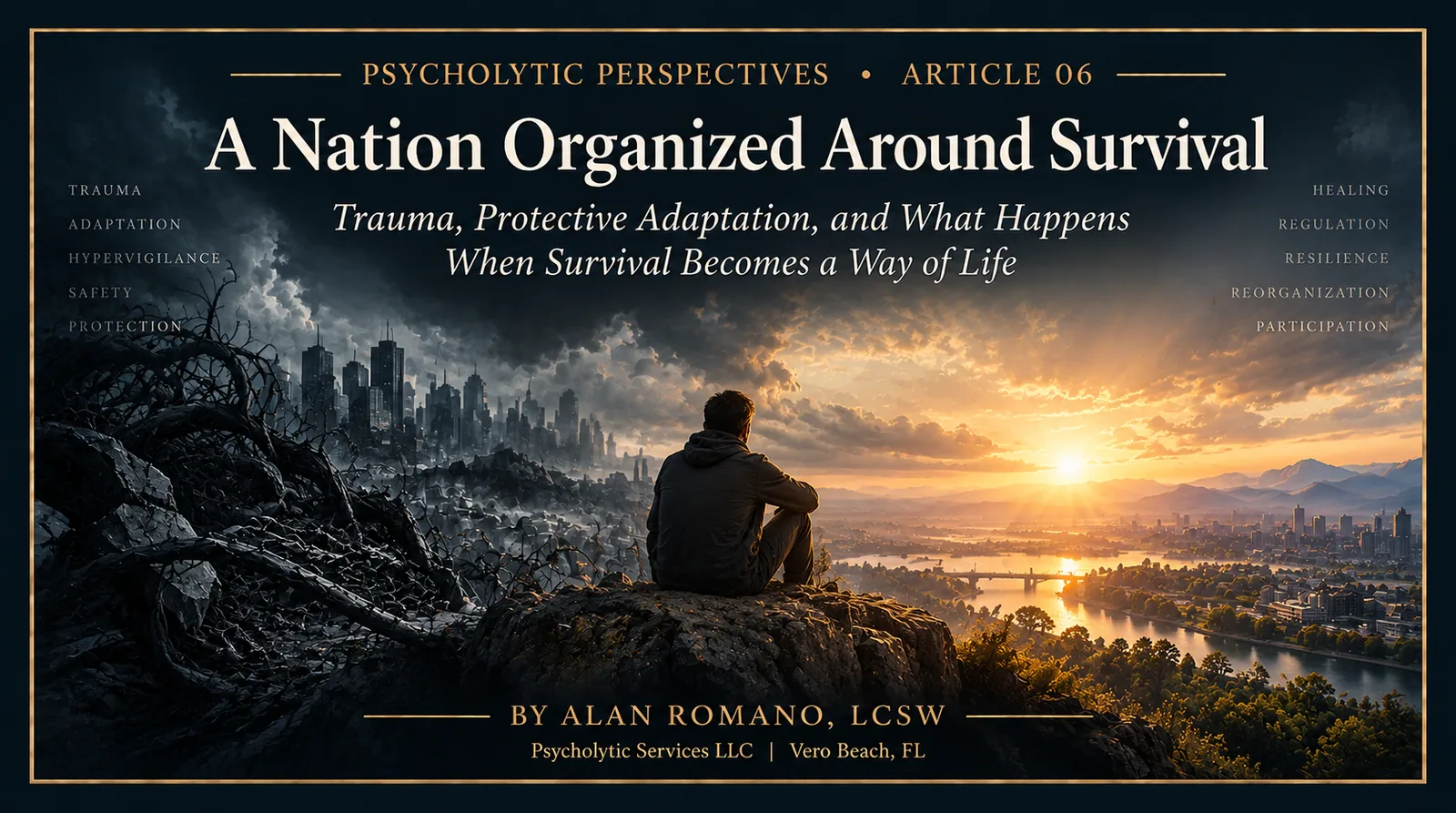
Trauma, Protective Adaptation, and What Happens When Survival Becomes a Way of Life
A nation organized around survival
We have spent decades asking how to treat trauma and reduce its symptoms. Perhaps we have spent too little time asking how human beings have become organized around survival, why those adaptations persist, and what happens when the conditions that once required protection continue shaping the way we live.
BY ALAN ROMANO, LCSW · Psycholytic Services LLC | Vero Beach, Florida
A Nation That Learned to Survive
America has become increasingly familiar with the language of trauma. Terms such as triggered, hypervigilance, dissociation, and trauma response have moved beyond clinical settings and entered everyday conversations. Growing awareness of post-traumatic stress disorder, adverse childhood experiences, and the lasting effects of abuse and neglect has expanded our understanding of human suffering (Felitti et al., 1998; Herman, 1992). Yet much of the conversation continues to approach trauma as something that happened to an individual, leaving behind symptoms to be identified, managed, and treated.
This understanding has contributed to meaningful advances in mental health care. Trauma-focused psychotherapies, neuroscience, and decades of research have helped explain why experiences of danger can continue influencing emotional, physiological, and behavioral responses long after an event has ended. But understanding the persistence of trauma symptoms is not necessarily the same as understanding how an entire life can become organized around survival, particularly when the conditions requiring protection are not entirely confined to the past.
Not every experience that leaves an emotional wound meets the clinical definition of traumatic exposure. Experiences of rejection, humiliation, relational instability, or chronic emotional neglect can influence how a person understands safety, connection, and vulnerability without necessarily meeting the diagnostic exposure criteria for post-traumatic stress disorder. Within FSRT, emotional wounding offers a broader descriptive lens for examining how difficult experiences shape protective adaptations, while preserving the clinical distinction between adversity, traumatic exposure, and trauma-related disorders.
Consider someone raised in an environment where emotional safety was unpredictable. They may have learned to recognize subtle changes in another person's voice, anticipate conflict, suppress their needs, or withdraw before vulnerability created another opportunity for rejection. These responses may develop without conscious intention, gradually becoming familiar ways of navigating relationships and uncertainty. What began as an adaptation to a particular environment can become an enduring pattern of organization.
Years later, that individual may have established a career, developed meaningful relationships, and created a life considerably safer than the one they once knew. Yet conflict may still activate expectations of abandonment, vulnerability may still feel dangerous, and rest may produce uneasiness rather than relief. The person may recognize that their circumstances have changed while continuing to respond through patterns established when protection was necessary. These responses do not necessarily indicate a failure to recover. They may reflect adaptations that became deeply established because they once helped the person survive.
For others, the conditions have not changed enough. Violence, economic insecurity, discrimination, unstable housing, and unpredictable relationships can continue demanding vigilance and protection. In these circumstances, what appears to be a trauma response may reflect both previous experience and present reality. Asking someone to relinquish protective adaptations becomes considerably more complicated when their environment continues reinforcing the need for them.
Functional Systems Regulation Theory approaches trauma through this wider understanding of human organization. Rather than examining symptoms exclusively within the individual, FSRT considers how biological, psychological, relational, cultural, and environmental conditions shape what a person learns to anticipate, tolerate, express, and sustain. Trauma may organize substantial portions of a person's available capacity around maintaining safety, avoiding vulnerability, and preparing for danger, even when those patterns eventually restrict the life the person hopes to live.
This perspective does not diminish the significance of traumatic events or the importance of evidence-based treatment. It broadens the inquiry to include the adaptations that developed around those experiences, the conditions that continue sustaining them, and what might allow the system to organize itself differently.
What happens when surviving is no longer simply a response to danger, but becomes the organizing principle through which a person experiences life?
When Survival Becomes Adaptation
Human beings do not respond to overwhelming experiences in identical ways. What becomes protective for one person may look very different for another, depending on developmental history, available relationships, environmental conditions, and the resources accessible when danger occurs. Some individuals become highly vigilant, learning to anticipate subtle signs of threat. Others withdraw emotionally, avoid conflict, seek control, or become exceptionally attentive to the needs and expectations of those around them. These responses may eventually create difficulties, but they often develop within circumstances where adaptation serves a protective purpose.
A child who learns that expressing anger leads to punishment may become unusually agreeable. Someone exposed to repeated abandonment may begin distancing themselves before others have an opportunity to leave. A person who has experienced prolonged unpredictability may develop an intense need for structure and control, while someone repeatedly overwhelmed by experiences, they could neither escape nor influence may respond through emotional numbing or dissociation. What later appears as avoidance, rigidity, or disconnection may have emerged through attempts to preserve safety, reduce distress, or maintain relationships under difficult conditions.
These patterns are not necessarily deliberate choices. Repeated experiences can shape expectations, emotional responses, and learned behavioral strategies until certain reactions become increasingly automatic, a process consistent with research on threat learning and conditioned responses (Craske et al., 2014). The person may no longer consciously evaluate whether protection is necessary before responding. Their system has learned which responses were previously associated with reducing danger or making overwhelming experiences more manageable.
Within Functional Systems Regulation Theory, this understanding reflects the principle Assume Intelligence Before Dysfunction. Rather than beginning with the assumption that a troubling behavior represents something defective within the individual, FSRT asks what conditions may have contributed to its development and what function it may have served. This does not mean every response is beneficial, or that all patterns can be explained as successful adaptations. It means that understanding the organization of a response should precede efforts to change it.
The difficulty emerges when an adaptation developed under one set of conditions continues operating across circumstances where it is no longer necessary or begins interfering with other needs. Hypervigilance may protect against unexpected danger while making rest difficult. Emotional withdrawal may reduce vulnerability while limiting intimacy. Control may create predictability while restricting flexibility. The very responses that once helped someone navigate threatening circumstances can eventually constrain their capacity for connection, spontaneity, and meaningful participation.
What once helped a person survive may eventually become part of what makes it difficult to live differently.
Understanding trauma through adaptation therefore changes the clinical question. Rather than asking only how to eliminate a symptom, we begin examining what the response developed to accomplish, why it remains accessible, and what conditions might allow the person to experience greater flexibility without losing the sense of protection the pattern once provided.
An FSRT perspective: The Intelligence of Survival
A behavior that appears dysfunctional in the present may have developed as an intelligent adaptation to conditions the system once had to endure. Protection can become deeply organized within the system, even when the circumstances that originally required it have changed.
Before asking why a person cannot stop a pattern, we might ask what that pattern once made possible.
When the Past Becomes the Present
Time can separate us from an experience without necessarily changing how we respond to what it taught us. A person may know that an abusive relationship has ended, that childhood is behind them, or that the environment in which they once felt threatened no longer exists. Yet a particular tone of voice, facial expression, physical sensation, or moment of uncertainty can evoke responses that seem disproportionate to what is happening in the present. The individual may understand that they are safe while experiencing fear, tension, withdrawal, or an overwhelming need to escape.
Traumatic experiences can shape more than conscious memory. They can influence how the nervous system detects potential danger, how emotional responses become associated with particular cues, and how a person learns to anticipate what may happen next. Research on fear conditioning and threat learning suggests that experiences associated with danger can influence subsequent responses to environmental cues, sometimes producing protective reactions even when the original threat is no longer present (Lissek & van Meurs, 2015). These learned associations involve interacting processes of memory, emotional responding, and physiological regulation, allowing previously established expectations of danger to influence present experience. The system does not necessarily wait for conscious recognition before responding.
Consider someone who grew up in a household where silence frequently preceded conflict. As an adult, a partner becoming unusually quiet may immediately produce anxiety, even when silence has nothing to do with anger or rejection. The person may begin searching for what they have done wrong, attempting to repair a conflict that has not occurred, or withdrawing to avoid an anticipated confrontation. What appears to be an excessive reaction to an ordinary moment may reflect an expectation developed through repeated experiences in which similar circumstances carried a very different meaning.
These responses can be particularly confusing because intellectual understanding does not always produce an immediate change in emotional or physiological experience. Someone may recognize that their partner is not their parent, that a current disagreement is not a previous assault, or that an unfamiliar environment is not inherently threatening. Yet the body may become activated before the person has an opportunity to evaluate the situation. Knowing that something is different does not necessarily mean the system has developed the capacity to experience it differently.
This does not mean that traumatic memories are literally stored in the body independently of the brain, or that every uncomfortable response can be traced to trauma. Rather, learning and memory involve interacting neural, physiological, emotional, and behavioral processes. Experiences of danger can influence these processes in ways that persist beyond conscious recollection, particularly when threatening circumstances were repeated, unpredictable, or encountered during important periods of development.
Within FSRT, this persistence can be understood through the relationship between previous adaptation and present organization. A protective response may have developed within one relational or environmental context and become increasingly available across others. When circumstances change, the system may continue responding through patterns that previously helped it anticipate danger, preserve connection, or reduce uncertainty. The current experience is therefore shaped not only by what is happening now, but also by what the system has learned to expect.
The past does not have to be consciously remembered for its influence to remain present. Nor does its influence mean that the person is permanently bound to the organization it helped establish. New experiences of safety, predictable relationships, effective treatment, and repeated opportunities to respond differently can gradually change what the system anticipates and what it becomes capable of sustaining.
The event may have ended, but the organization developed around it may still be shaping the present.
When Protection Becomes a Way of Life
Protective adaptations do not always remain isolated responses to particular experiences. Over time, they can become familiar ways of interpreting the world, navigating relationships, and responding to uncertainty. A person who once needed to remain vigilant may begin anticipating danger even in relatively safe environments. Someone who learned to suppress their emotions to preserve connection may struggle to express vulnerability, even with people they trust. What began as a response to particular circumstances can gradually influence how the individual organizes everyday life.
This creates a difficult paradox. Emotional distance may produce loneliness, yet closeness may feel threatening. Control may create exhaustion, yet uncertainty may feel intolerable. Avoidance may limit opportunities for growth, yet confronting unfamiliar experiences may activate the very distress the person has learned to prevent. The individual may recognize the suffering these patterns create while continuing to experience them as necessary.
Within Functional Systems Regulation Theory, Homeostatic Patterning describes how living systems develop and return to familiar forms of organization they have learned to sustain. These patterns are not necessarily healthy, comfortable, or consciously preferred. Repeated experiences can make certain responses more accessible and predictable than alternatives, allowing familiarity to become mistaken for safety, even when it restricts the possibilities available to the individual.
Consider someone who has spent much of their life anticipating rejection. They may genuinely desire intimacy while becoming uncomfortable when a relationship offers consistency, affection, and emotional availability. Without intending to, they may withdraw, question the relationship, or search for signs that something will eventually go wrong. These responses do not necessarily reflect a desire for suffering. They may reveal how deeply expectations of instability have shaped the person's experience of connection.
Similar patterns can influence work, rest, identity, and self-worth. Someone accustomed to functioning under constant pressure may struggle to rest without guilt. A person who learned to maintain safety by meeting everyone else's needs may find it difficult to recognize their own. The absence of danger does not automatically create the capacity to experience safety.
These patterns are neither universal nor permanent. Many people demonstrate substantial resilience following trauma, and protective responses can change as circumstances, relationships, and capacities develop (Bonanno, 2004). For those whose lives have become organized around anticipating threat, however, change may require more than recognizing that a response is no longer necessary. It may involve developing greater flexibility, supportive relationships, and opportunities to experience unfamiliar situations without automatically returning to established forms of protection.
Healing, from this perspective, involves examining not only the unwanted response but also the conditions that continue sustaining it. Understanding why a pattern developed can create an opportunity for change, but it does not guarantee that a different response has become sustainable.
A person may be ready to leave a painful pattern behind before their system has developed the capacity to sustain something different.
An FSRT perspective: When Survival Becomes Organization
Within FSRT, Homeostatic Patterning helps explain why protective adaptations can persist even when they create suffering. Familiar patterns may restore predictability and reduce uncertainty without necessarily providing genuine safety or well-being.
The system does not always return to what is healthy. It often returns to what it has learned it can sustain.
When the Conditions of Emotional Wounding Persist
Much of our understanding of trauma begins with the assumption that something happened, the experience ended, and the individual is now living with its consequences. This is often true, but it does not account for those whose lives continue unfolding within the very conditions that contributed to their emotional wounding. For someone living with ongoing violence, relational instability, economic insecurity, or persistent uncertainty, the distinction between past experiences and present danger may be considerably less clear. What appears to be an enduring trauma response may also be an adaptation to circumstances that continue demanding protection.
Consider someone who grew up in an emotionally unpredictable household and later enters relationships characterized by similar instability. Their vigilance, emotional withdrawal, or difficulty trusting others may be understood through earlier experiences, but those responses may also reflect the demands of their current environment. Similarly, someone facing chronic financial insecurity may experience persistent anxiety not simply because their nervous system has become overly sensitive to threat, but because the possibility of losing housing, employment, or access to essential resources remains a genuine concern. In these circumstances, asking the individual to experience greater safety without examining the conditions shaping their distress risks overlooking what their responses may be communicating.
Emotional wounding does not occur exclusively through isolated events. Repeated experiences of rejection, humiliation, neglect, coercion, or unpredictability can gradually shape how people understand themselves, relate to others, and anticipate what may happen within relationships. Research on adverse childhood experiences and prolonged traumatic exposure provides important context for understanding how sustained adversity can influence psychological development and patterns of adaptation (Felitti et al., 1998; Herman, 1992). Although not every experience of emotional wounding meets formal diagnostic criteria for traumatic exposure, its cumulative influence deserves consideration when examining how people develop expectations about safety, belonging, and their capacity to influence the circumstances of their lives.
The environments in which people live can also reinforce the protective patterns that earlier experiences helped establish. A person who learned to remain silent to avoid conflict may discover that speaking openly continues to carry consequences within their family or workplace. Someone who developed independence in response to unreliable caregiving may continue encountering relationships where relying on others carries genuine emotional or practical risks. In these circumstances, protective patterns may persist not simply because they have become familiar, but because the surrounding conditions continue to reinforce their usefulness.
Within Functional Systems Regulation Theory, the individual cannot be understood apart from the Living Field, the interconnected biological, psychological, relational, cultural, and environmental systems within which human experience emerges. When these systems continually expose someone to instability or threat, regulation becomes more than an individual psychological task. The person's available capacity is shaped by the demands of the environment, the resources accessible to them, and the degree to which their relationships and circumstances support or undermine safety.
This creates an important consideration for psychotherapy. Helping someone develop emotional regulation, recognize maladaptive patterns, and respond more flexibly can be profoundly beneficial. Yet treatment cannot always resolve the conditions that continue producing distress. A person may learn to manage anxiety while remaining financially insecure, develop healthier boundaries while living within a coercive relationship, or gain insight into protective responses while continuing to encounter environments that reinforce them. Clinical progress and environmental change do not always occur together.
Recognizing these conditions does not mean that individuals are powerless to change until their environment becomes ideal. Human beings can develop resilience, agency, and meaningful psychological flexibility even under considerable adversity. It does mean that healing should not be measured exclusively by how effectively someone learns to tolerate circumstances that may themselves require attention or change.
Sometimes the system continues protecting itself because the conditions that wounded it have never fully stopped demanding protection.
We cannot ask a person to stop organizing around danger while ignoring the conditions that continue making danger a part of their daily life.
The Hidden Cost of Remaining Prepared
Living in a state of persistent readiness carries a cost that is not always visible to others. A person may appear productive, responsible, attentive, and capable while devoting considerable internal resources to anticipating what might go wrong. They may carefully monitor the emotional states of others, rehearse difficult conversations before they occur, or struggle to relax even when there is no immediate demand requiring their attention. What appears externally as competence or self-discipline may sometimes coexist with an exhausting effort to maintain a sense of safety.
The human stress response is designed to help us respond to challenges and potential danger. When activated appropriately, it can sharpen attention, mobilize energy, and prepare the body for action. Difficulties can emerge when heightened readiness becomes frequent or prolonged, particularly when opportunities for recovery are limited. Sustained activation of stress-response systems can contribute to physiological strain and interfere with processes involved in health and recovery (McEwen, 1998). The system continues allocating resources toward protection, leaving fewer resources available for other aspects of living.
These demands can accumulate across seemingly unrelated areas of life. Someone who remains vigilant within relationships may also struggle to concentrate at work, experience difficulty making decisions, or feel overwhelmed by ordinary responsibilities. A person who has learned to anticipate rejection may expend considerable energy interpreting social interactions, managing how they are perceived, and avoiding situations that could expose them to criticism. Over time, maintaining protection can become so familiar that the individual no longer recognizes how much effort it requires.
Within Functional Systems Regulation Theory, Regulatory Burden describes the cumulative demands placed upon a living system as it attempts to maintain stability, respond to challenges, and sustain participation across multiple dimensions of life. These demands are not exclusively psychological. They emerge through interactions among biological functioning, emotional experience, relationships, environmental conditions, and the resources available to meet ongoing needs. When protective vigilance becomes a persistent requirement, it can consume capacity that might otherwise support flexibility, connection, creativity, and recovery.
This offers another way of understanding experiences commonly described as emotional exhaustion, difficulty concentrating, irritability, or withdrawal. Such experiences can arise for many reasons and should not automatically be attributed to trauma. Yet for some individuals, they may reflect the cumulative cost of remaining prepared for danger. A person may appear disengaged when they are overwhelmed, inattentive when their attention is repeatedly drawn toward potential threats, or emotionally unavailable when maintaining stability already requires much of their available capacity.
The consequences extend beyond the individual. Relationships may become strained when ordinary disagreements activate protective responses, while opportunities for intimacy may feel demanding rather than restorative. Workplaces that reward constant availability and high performance can reinforce patterns of overextension, particularly for people who have learned to associate productivity with security or personal worth. Even rest can become difficult when slowing down creates space for sensations, emotions, or uncertainty that sustained activity has helped keep at a distance.
Reducing this burden involves more than teaching someone to tolerate greater amounts of stress. Effective treatment, supportive relationships, predictable environments, meaningful boundaries, and opportunities for recovery can all contribute to expanding regulatory capacity. Equally important is recognizing when the demands themselves need to change. A system cannot indefinitely devote increasing resources to protection without consequences for the other dimensions of life it is attempting to sustain.
When so much of a person's capacity is devoted to preparing for what might happen, less remains available for experiencing what is possible.
Why Understanding Does Not Equal Reorganization
There is a particular frustration that can emerge when someone understands the origins of their suffering but continues experiencing the same patterns they have worked so hard to change. They may recognize why conflict activates fear, understand how childhood experiences shaped their relationships, or identify the protective responses that have followed them into adulthood. They may have spent years in psychotherapy, developed considerable self-awareness, and gained meaningful insight into their emotional lives. Yet when confronted with familiar circumstances, the same reactions can return, sometimes with an intensity that seems to contradict everything they have come to understand.
This experience is often interpreted as resistance, avoidance, or an inability to apply what has been learned. Yet intellectual understanding and the capacity to respond differently are not identical processes. Recognizing why a pattern developed does not automatically change the emotional, physiological, and relational responses through which it continues operating. A person may understand that vulnerability is no longer inherently dangerous while still experiencing the bodily tension, uncertainty, and impulse to withdraw that vulnerability evokes. Insight can illuminate the organization of a response without immediately changing the conditions that sustain it.
Within Functional Systems Regulation Theory, Integration as Reorganization describes the process through which new understanding, experiences, and possibilities become increasingly sustainable within everyday life. Meaningful insight may initiate this process, but lasting change involves more than recognizing the past or adopting a different perspective. It requires developing the capacity to experience, respond, and participate differently across the situations and relationships in which familiar patterns have been maintained.
Consider someone who recognizes that their need for control developed within an unpredictable childhood environment. Through therapy, they may understand how uncertainty became associated with danger and why controlling their surroundings once provided a sense of security. Yet relinquishing control may still activate significant anxiety. The individual does not necessarily need another explanation of why the pattern exists. They may need repeated opportunities to experience uncertainty without becoming overwhelmed, supportive relationships in which vulnerability is met with consistency, and sufficient regulatory capacity to remain present while unfamiliar responses gradually become more accessible.
Evidence-based trauma-focused psychotherapies can support recovery by addressing traumatic memories, avoidance, and trauma-related beliefs and responses (U.S. Department of Veterans Affairs & U.S. Department of Defense, 2023). Different individuals may benefit from different interventions, and meaningful recovery does not require every person to follow the same therapeutic sequence. What remains essential is recognizing that the ability to sustain change depends on more than the accuracy of one's understanding. It is also influenced by present safety, available support, the demands placed upon the individual, and opportunities to develop new patterns through experience.
This is particularly relevant when therapeutic progress is measured primarily through symptom reduction or the ability to articulate insight. A person may report fewer symptoms while continuing to organize relationships around avoidance, or demonstrate considerable psychological understanding while struggling to translate that understanding into daily life. Conversely, meaningful reorganization may become visible through seemingly ordinary changes: remaining present during disagreement, expressing a need without anticipating rejection, tolerating uncertainty without immediately seeking control, or allowing rest without experiencing it as a threat.
These changes may appear modest when viewed individually, yet they can reflect an expanding capacity to participate in life beyond the protective organization that once dominated it. Reorganization is not the elimination of every fear, protective response, or painful memory. It is the gradual development of greater flexibility, allowing the person to recognize danger when it is present without requiring every unfamiliar experience to be approached as though danger is inevitable.
Insight may change how we understand our suffering, but reorganization changes how we participate in life. The difference is not what we know, but what our system has developed the capacity to sustain.
When Healing Meets the World That Wounded Us
Healing can begin within the safety of a therapeutic relationship, but it must eventually encounter the world in which a person lives. Someone may develop greater emotional awareness, recognize protective patterns, and discover new ways of responding to experiences that once felt overwhelming. Yet the relationships and environments they return to may either support these emerging capacities or continue demanding the very adaptations they are attempting to move beyond.
Consider someone who has spent years suppressing their needs to avoid conflict. Through psychotherapy, they may begin developing healthier boundaries and practicing more direct communication. But what happens when expressing those needs continues to produce criticism, hostility, or rejection? The individual may possess the insight and skills necessary to respond differently, yet their environment may continue reinforcing the need for protection. What appears to be difficulty applying therapeutic progress may also reflect circumstances in which familiar adaptations remain necessary.
The opposite can also occur. Someone who has learned to anticipate rejection may gradually encounter relationships characterized by consistency, responsiveness, and emotional availability. These experiences create opportunities to practice vulnerability without repeatedly encountering the consequences they once expected. Over time, new patterns of connection may become increasingly accessible, not simply through changes in thinking, but through relationships that offer different experiences of safety and belonging.
Within Functional Systems Regulation Theory, these processes unfold within the Living Field, the interconnected biological, psychological, relational, cultural, and environmental systems through which human experience emerges. A person's developing capacity for regulation may be supported by predictable relationships, meaningful community participation, and greater stability, or challenged by insecurity, isolation, and circumstances that demand persistent vigilance. The same individual may demonstrate considerable flexibility in one environment while finding familiar protective responses activated in another.
The importance of considering social and environmental conditions alongside individual psychological experience is also reflected in research on the social determinants of mental health (World Health Organization & Calouste Gulbenkian Foundation, 2014).
This perspective also invites us to reconsider how therapeutic progress is evaluated. Symptom reduction, improved emotional regulation, and increased psychological flexibility are meaningful outcomes, but they do not necessarily capture the full extent of reorganization. Someone may experience substantial progress within treatment while continuing to struggle in environments that repeatedly activate protective responses. Conversely, changes in relationships, living conditions, or access to support may create opportunities for growth that were previously difficult to sustain.
Recovery does not require ideal circumstances, nor does psychotherapy become ineffective when environmental conditions remain challenging. People can develop meaningful resilience and agency even while navigating considerable adversity. Yet there is a difference between helping someone expand their regulatory capacity and expecting them to accommodate conditions that continue undermining their well-being. Sometimes healing involves responding differently within an existing environment. At other times, it may require establishing boundaries, seeking healthier relationships, or changing circumstances that no longer support the life a person is attempting to build.
Within FSRT, Integration as Reorganization becomes increasingly evident when emerging capacities begin influencing how a person relates, makes choices, establishes boundaries, and participates in everyday life. The therapeutic relationship may help create new possibilities, but meaningful reorganization involves developing the capacity to sustain those possibilities within the larger Living Field.
We cannot fully understand healing by examining what changes within a person while ignoring what remains unchanged in the world to which they return.
An FSRT perspective: From Survival to Reorganization
Healing does not require the system to forget what it survived or abandon the adaptations that once provided protection. Reorganization becomes possible as new experiences, relationships, environments, and capacities allow the individual to respond differently without sacrificing their need for safety.
The goal is not to erase the survival response, but to expand the possibilities available beyond it.
Beyond Survival: Reclaiming the Capacity to Live
What becomes possible when a person no longer has to organize so much of their life around protection? When silence no longer automatically signals danger, vulnerability no longer requires withdrawal, and uncertainty no longer demands immediate control? For someone whose experiences have taught them to anticipate harm, these changes may represent far more than the reduction of symptoms. They may reflect the gradual emergence of a life in which attention, energy, and emotional capacity become available for experiences that survival once made difficult to sustain.
Healing does not require forgetting what happened, eliminating every protective response, or becoming incapable of recognizing danger. The capacity to protect ourselves remains essential to human life. What can change is the extent to which protection governs our relationships, decisions, identities, and possibilities. A person may begin to experience disagreement without anticipating abandonment, rest without guilt, intimacy without constant vigilance, or uncertainty without immediately retreating into familiar patterns. These changes may appear ordinary from the outside, yet they can represent profound shifts in how a person participates in the world.
Within Functional Systems Regulation Theory, this is the movement from survival-based organization toward greater flexibility, coherence, and participation within the Living Field. Reorganization does not erase the intelligence of earlier adaptations. It expands the system's capacity to respond to present circumstances without remaining exclusively governed by the conditions of the past. The individual is not becoming someone untouched by suffering, but someone increasingly capable of living beyond the limitations that suffering once imposed.
For someone who has spent years organizing life around survival, the possibility of living differently may introduce questions that are as unfamiliar as they are liberating. Who am I when I am no longer defined by what I must endure? What do I want when my decisions are no longer governed primarily by what I need to avoid? These questions are not always easily answered. Protective adaptations may have shaped not only how a person responds to the world, but also how they understand their identity, recognize their needs, and imagine their future. As those adaptations become less dominant, the individual may encounter an unfamiliar freedom, one that requires discovering possibilities they have rarely had the capacity or opportunity to consider.
One of the most profound expressions of healing is not simply the ability to remain calm in circumstances that once felt threatening, but the gradual emergence of a life organized around something worth moving toward. Curiosity may begin to replace constant anticipation, connection may become possible without the expectation of loss, and choices may increasingly reflect personal meaning rather than the need to prevent suffering. These changes do not make a person immune to fear, uncertainty, or future adversity. They suggest that survival, while remaining an essential human capacity, no longer has to determine the boundaries of an individual's existence.
Yet the possibility of living beyond survival cannot remain solely an individual responsibility. We cannot continue asking people to develop greater emotional regulation while overlooking the relationships, institutions, and environments that repeatedly undermine it. We cannot speak meaningfully about healing without also examining the conditions in which people are expected to live, work, connect, raise families, and find belonging. A society that becomes increasingly sophisticated at treating the consequences of emotional wounding must also be willing to confront the circumstances that continue producing it.
Perhaps the question is no longer simply how we help people recover from what they have survived. Perhaps we must also ask what kind of world we are creating, and whether that world allows human beings to organize their lives around something more than anticipation of harm. If healing involves expanding the capacity to participate more fully in life, then our responsibility extends beyond helping individuals adapt to the world as it exists. It also involves examining whether the world we are collectively creating makes that participation possible.
Survival is one of humanity’s greatest capacities. But when survival becomes the way we organize our lives, we risk spending a lifetime protecting ourselves from the very life we are trying to preserve.
Perhaps the most meaningful place to begin is by examining where survival continues shaping our own lives. Not to judge the adaptations that brought us here, but to consider whether the conditions that once made them necessary still define what we believe is possible.
A question for reflection
What parts of your life have become organized around protection rather than possibility, and what would need to change, within you or in the world around you, for something different to become sustainable?
Therapy outcomes vary from person to person. No result is promised or guaranteed.
About the author
Alan Romano, LCSW
Alan Romano, LCSW, is a Florida Licensed Clinical Social Worker and founder of Psycholytic Services LLC. His clinical work integrates trauma-informed psychotherapy, somatic approaches, Internal Family Systems (IFS), ketamine-assisted psychotherapy, and Functional Systems Regulation Theory (FSRT).
If you are the person this is about
If something in this article reflects what you have been experiencing, therapy can offer a place to understand the pattern with greater depth, safety, and compassion.
Psycholytic Services offers in-person therapy in Vero Beach and secure virtual therapy throughout Florida.
References
- Bonanno, G. A. (2004). Loss, trauma, and human resilience: Have we underestimated the human capacity to thrive after extremely aversive events? American Psychologist, 59(1), 20–28. https://doi.org/10.1037/0003-066X.59.1.20
- Craske, M. G., Treanor, M., Conway, C. C., Zbozinek, T., & Vervliet, B. (2014). Maximizing exposure therapy: An inhibitory learning approach. Behaviour Research and Therapy, 58, 10–23. https://doi.org/10.1016/j.brat.2014.04.006
- Felitti, V. J., Anda, R. F., Nordenberg, D., Williamson, D. F., Spitz, A. M., Edwards, V., Koss, M. P., & Marks, J. S. (1998). Relationship of childhood abuse and household dysfunction to many of the leading causes of death in adults: The Adverse Childhood Experiences (ACE) Study. American Journal of Preventive Medicine, 14(4), 245–258. https://doi.org/10.1016/S0749-3797(98)00017-8
- Herman, J. L. (1992). Complex PTSD: A syndrome in survivors of prolonged and repeated trauma. Journal of Traumatic Stress, 5(3), 377–391. https://doi.org/10.1002/jts.2490050305
- Lissek, S., & van Meurs, B. (2015). Learning models of PTSD: Theoretical accounts and psychobiological evidence. International Journal of Psychophysiology, 98(3), 594–605. https://doi.org/10.1016/j.ijpsycho.2014.11.006
- McEwen, B. S. (1998). Protective and damaging effects of stress mediators. The New England Journal of Medicine, 338(3), 171–179. https://doi.org/10.1056/NEJM199801153380307
- U.S. Department of Veterans Affairs, & U.S. Department of Defense. (2023). VA/DoD clinical practice guideline for the management of posttraumatic stress disorder and acute stress disorder (Version 4.0). https://www.healthquality.va.gov/guidelines/MH/ptsd/
- World Health Organization, & Calouste Gulbenkian Foundation. (2014). Social determinants of mental health. https://www.who.int/publications/i/item/9789241506809
Psycholytic Perspectives
Subscribe for updates on new Psycholytic Perspectives articles