
Please note
Reading this site, or contacting me through it, does not create a therapist and client relationship. Nothing here is clinical advice for your situation.
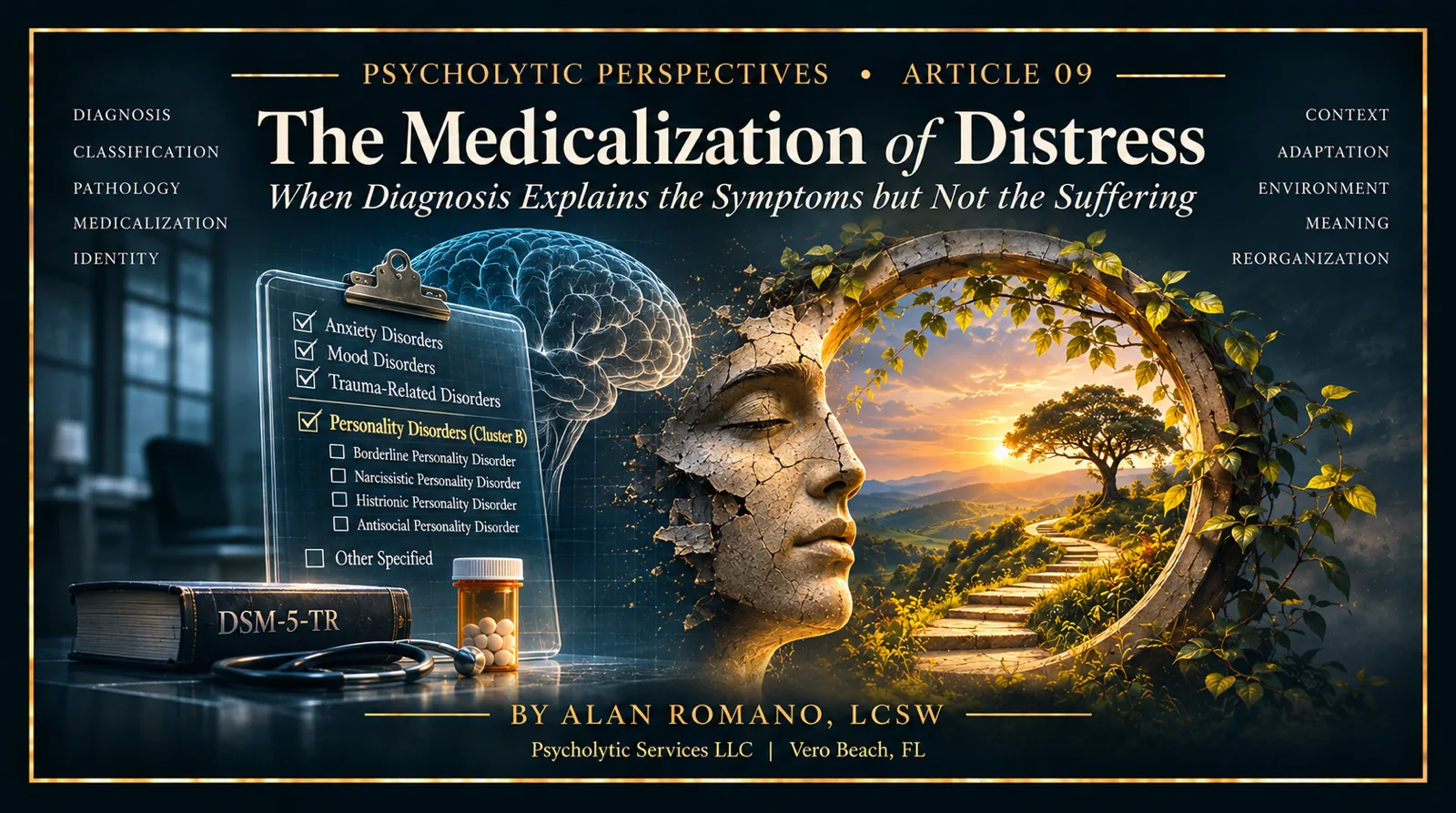
When Diagnosis Explains the Symptoms but Not the Suffering
The medicalization of distress
We have become increasingly sophisticated at identifying and treating the symptoms of human suffering. Yet our ability to name distress does not necessarily mean we understand the conditions that gave rise to it, the functions it serves, or what must change for it to no longer be necessary.
BY ALAN ROMANO, LCSW · Psycholytic Services LLC | Vero Beach, Florida
When Suffering Enters the Clinical System
A person enters treatment carrying years of emotional pain. Perhaps they struggle with anxiety, persistent sadness, difficulty maintaining relationships, or reactions they cannot fully explain. Their experiences are assessed, their symptoms organized, and a diagnosis established. What once felt confusing may finally have a name.
For many, this recognition brings relief. A diagnosis can validate suffering, guide treatment, and provide access to necessary care. Yet something important may be overlooked when the language used to describe a person's difficulties begins to substitute for an understanding of the life in which those difficulties emerged.
Fear may have developed in an environment where safety was uncertain. Emotional withdrawal may have protected against repeated rejection. A persistent need for reassurance may reflect years of relational instability. What appears dysfunctional in the present may have developed through circumstances in which those responses served an important purpose. Recognizing these possibilities does not invalidate a diagnosis. It invites us to consider what the diagnosis alone cannot explain.
Psychiatric classification provides an essential clinical language, but it is not a complete account of psychological functioning. Contemporary scholarship emphasizes the importance of interpreting diagnostic categories within comprehensive clinical evaluation rather than relying upon any single framework to explain the complexity of human experience (Aftab et al., 2024).
The question, then, is not whether we should diagnose human suffering. It is whether we have come to mistake the ability to classify distress for the ability to understand it.
How Suffering Became Something to Classify
The Diagnostic and Statistical Manual of Mental Disorders (DSM) was developed to establish a shared framework for identifying and communicating patterns of psychological disturbance. Its standardized criteria support clinical assessment, research, treatment planning, and consistency across professional settings (American Psychiatric Association, 2022).
A DSM diagnosis identifies a clinically significant pattern involving cognition, emotional regulation, or behavior. Depending on the disorder, diagnostic criteria consider symptoms, duration, severity, functional impairment, exclusions, and other relevant clinical features. Importantly, the DSM recognizes that expected responses to loss, culturally accepted experiences, and differences from prevailing social expectations do not, by themselves, constitute mental disorders (American Psychiatric Association, 2022).
This distinction reflects an important clinical responsibility: recognizing when human experiences warrant intervention without assuming that every expression of distress represents pathology.
Fear, sadness, emotional sensitivity, impulsivity, and variations in attention exist along the spectrum of ordinary human experience. Their clinical significance depends not simply upon their presence, but upon their intensity, persistence, context, associated dysfunction, and the ways they affect an individual's life.
Yet the boundaries between ordinary variation and psychopathology are not always clearly defined. The Hierarchical Taxonomy of Psychopathology (HiTOP) offers an alternative framework that organizes psychological symptoms and maladaptive traits along continuous dimensions, ranging from specific experiences to broader patterns of psychopathology (Krueger, 2025). This approach challenges the assumption that psychological disorders always represent distinct categories and raises important questions about how diagnostic boundaries are established and whether they adequately reflect the complexity of human psychological functioning.
Culture adds another dimension. What is considered excessive, disruptive, or acceptable cannot always be separated from the social environments in which behavior occurs. A response viewed as problematic in one context may be understandable, expected, or even protective in another. Although diagnostic systems increasingly acknowledge these considerations, classification necessarily organizes experiences that emerge through interacting biological, developmental, relational, cultural, and environmental processes.
The challenge is not that classification lacks value. It is that the categories through which we organize suffering can begin to shape what we recognize, what we investigate, and what we overlook.
When Diagnosis Becomes Identity
Psychiatric diagnosis no longer belongs exclusively to the clinical encounter.
Diagnostic language now extends far beyond clinical settings. Terms once primarily used by mental health professionals circulate through social media, classrooms, workplaces, and personal relationships. Increasingly, people encounter diagnostic categories before ever entering a clinical assessment.
Research suggests that broader public understandings of what constitutes a mental disorder are associated with greater self-diagnosis and help-seeking, even after accounting for reported distress and impairment (Tse & Haslam, 2024).
This expanding language can serve important purposes. People may recognize experiences they previously struggled to describe, discover supportive communities, and seek care they might otherwise have avoided. Yet the cultural adoption of diagnostic terminology also raises questions about how individuals come to understand themselves.
A diagnosis may begin as a description of what someone experiences and gradually become an explanation of who they believe themselves to be.
Someone who experiences persistent anxiety may begin to understand uncertainty as something they are inherently incapable of tolerating. A person who struggles with emotional regulation may come to regard relational instability as an unavoidable feature of their identity. What began as a recognizable pattern of functioning can become an anticipated limitation.
Research on mental illness identity examines this relationship between psychiatric conditions and self-concept. A recent scoping review found that identifying with a mental illness has complex and sometimes conflicting associations with help-seeking and health outcomes (Eddington & Badillo-Winard, 2025).
Experimental research also suggests that diagnostic labels can influence how others interpret an individual's difficulties, sometimes increasing empathy and perceived need for support while reducing expectations of personal control or recovery (Altmann et al., 2024).
These findings do not establish that diagnostic identification is inherently harmful. For many, it provides understanding, legitimacy, and belonging. The concern arises when the diagnosis becomes a fixed boundary around what someone believes is possible.
A diagnosis may give suffering a name, but it cannot tell the whole story of a life. We are more than the patterns that protected us, and more than the limitations those patterns have come to impose.
Within Functional Systems Regulation Theory, identity is not understood as separate from the patterns through which individuals have learned to regulate their lives. When diagnostic language becomes embedded within those patterns, it may influence not only how individuals interpret their experiences, but also the relationships they pursue, the challenges they avoid, and the possibilities they come to anticipate.
The pattern may be real. Its consequences may be significant. But neither establishes the limits of who the person may become.
When Naming Becomes Knowing
A further challenge emerges when diagnostic categories begin functioning as explanations rather than descriptions.
Consider someone who experiences persistent anxiety, anticipates rejection, and withdraws when relationships become emotionally demanding. A diagnosis may accurately describe aspects of this presentation. Yet attributing these responses solely to the diagnosis risks overlooking the developmental, relational, and environmental circumstances through which they emerged.
Why does uncertainty feel threatening? What has withdrawal helped the individual avoid or preserve? Under what conditions does the response become more pronounced, and when does it diminish?
These questions do not compete with diagnostic assessment. They deepen it by shifting attention from the presence of a symptom toward the conditions that give it meaning and may sustain its expression.
Aftab et al. (2024) emphasize that psychiatric diagnostic frameworks have different strengths and limitations and should be interpreted within comprehensive clinical evaluation. A diagnosis may inform treatment and prognosis without independently identifying the mechanisms responsible for the symptoms it describes.
Emotional withdrawal, for example, may emerge from fear, exhaustion, mistrust, depressed mood, or several interacting processes. Although two individuals may present with similar symptoms or share the same diagnosis, the circumstances that shaped their responses may differ considerably. These differences become clinically meaningful when considering which interventions may be helpful and what conditions are necessary for lasting change.
An FSRT perspective: Beyond the Diagnostic Name
Within FSRT, symptoms are understood within the Living Field, where biological, psychological, relational, and environmental conditions shape how a system learns to regulate itself.
Naming a person's suffering does not mean we understand the life that taught their system to carry it.
A diagnosis may be accurate without being sufficient. When classification becomes the endpoint of inquiry, treatment may address the visible symptoms while leaving the conditions that sustain them largely unchanged.
Within Functional Systems Regulation Theory, the Living Field describes the interconnected conditions through which a person's patterns of functioning emerge, become reinforced, and sometimes change. It invites us to look beyond the individual symptom and consider how personal history, relationships, physical environments, cultural expectations, and present circumstances participate in the organization of distress.
From this perspective, what appears pathological in the present may have developed as a necessary response to circumstances in the past. The question is not simply what is wrong with the individual, but how a particular way of functioning became familiar, what it once made possible, and why it may remain difficult to relinquish.
When Adaptation Becomes Pathology
Human beings do not develop their patterns of functioning independently of the environments in which they live. From childhood onward, we learn what is safe to express, what must be concealed, and which responses help us maintain connection, predictability, or protection.
Some of these adaptations become so deeply established that they are eventually experienced as enduring characteristics of personality.
A child raised amid unpredictable emotional reactions may become exceptionally attentive to changes in another person's mood. Someone repeatedly exposed to abandonment may learn to anticipate rejection before it occurs. A person whose needs were consistently dismissed may develop an intense sensitivity to perceived disapproval.
Over time, these responses may become familiar ways of navigating the world, persisting even when the circumstances that contributed to their development have changed. Research on adverse childhood experiences and developmental psychopathology demonstrates associations between early adversity and later psychological difficulties, although these relationships are neither uniform nor deterministic (Felitti et al., 1998; McLaughlin et al., 2020).
Consider an individual who becomes intensely distressed when a partner withdraws emotionally. They may seek repeated reassurance, struggle to regulate their emotions, or respond with anger when connection feels threatened. These behaviors may create substantial relational difficulties and warrant clinical assessment.
Yet the same presentation may emerge through different developmental and relational circumstances. Emotional withdrawal may have preceded abandonment earlier in life. Reassurance may temporarily quiet an expectation of rejection. The current relationship may itself be unstable, repeatedly reinforcing the very responses that have become problematic.
These possibilities are not mutually exclusive, nor do they eliminate the possibility of a diagnosable disorder.
Personality disorder classification offers a particularly relevant example. Contemporary research increasingly recognizes personality pathology through dimensions of severity and maladaptive traits alongside established categorical diagnoses (Widiger & Smith, 2025). This reflects the complexity of distinguishing enduring patterns of dysfunction from variations in personality and responses shaped by context.
Within Functional Systems Regulation Theory, identifying a pattern as maladaptive is not the conclusion of clinical inquiry. It is an invitation to understand how that pattern became organized, what regulatory purpose it may have served, and what continues to sustain it.
A behavior may cause suffering while also having developed to prevent suffering. Recognizing its protective origins does not excuse harmful behavior, diminish personal responsibility, or imply that the response remains necessary.
What appears dysfunctional in the present may once have helped preserve safety, connection, or predictability. Yet the strategies through which a person learned to survive can eventually restrict their capacity to participate more fully in life.
Someone may become exceptionally skilled at anticipating danger while struggling to experience safety. Another may preserve relationships through accommodation while gradually losing the ability to express their own needs.
The clinical task is neither to romanticize these adaptations nor to reduce them to pathology. It is to understand their development, recognize their present consequences, and help establish the regulatory capacity through which different responses become possible.
Yet even this understanding remains incomplete if we assume that the conditions sustaining distress exist only within the individual.
The Suffering We Locate in the Individual
Psychiatric assessment necessarily directs much of its attention toward the individual. We examine emotional experiences, behavioral patterns, cognitive functioning, symptom severity, and the extent to which these interfere with everyday life. Through this process, suffering becomes organized around the experiences and functioning of the person presenting for care.
Yet the conditions contributing to that suffering may extend far beyond the individual.
Someone living with financial insecurity may experience persistent anxiety about the future. A person navigating an emotionally abusive relationship may remain vigilant, anticipating subtle changes in another person's behavior. An individual working under chronic pressure may struggle with exhaustion, irritability, and difficulty concentrating.
These experiences may meet criteria for psychiatric disorders. Their relationship to external circumstances does not make them any less clinically significant. But when our attention remains focused primarily on the individual's symptoms, the conditions sustaining those symptoms may become secondary to the treatment process.
The World Health Organization (2022) identifies social, economic, and environmental circumstances as important influences on mental health, emphasizing that effective responses extend beyond individual treatment. Research on social determinants similarly demonstrates associations between poverty, discrimination, housing instability, employment conditions, social exclusion, and psychological vulnerability (Lund et al., 2018).
These findings challenge the assumption that the individual must always be the primary location of change.
Consider someone experiencing chronic anxiety while living in an unpredictable environment. Treatment may help them regulate physiological arousal, examine catastrophic expectations, and develop greater emotional flexibility. These are meaningful clinical accomplishments.
Yet when the environment continues to present genuine threats, some degree of vigilance may remain necessary.
A response shaped by previous danger may require opportunities for new learning. A response to continuing danger may also require changes in safety, resources, relationships, or living conditions. Both may benefit from psychotherapy, but neither can be adequately understood without considering the circumstances in which the response occurs.
An FSRT perspective: The Living Field of Distress
Within FSRT, regulation emerges through the Living Field, where biological, psychological, relational, and environmental conditions continuously influence one another. What appears to be an individual difficulty may also reflect the demands of the system in which a person is living.
We cannot ask a system to surrender its defenses while leaving untouched the conditions that continue to make those defenses necessary.
This perspective does not diminish individual agency or the value of evidence-based treatment. It recognizes that the capacity for change develops within conditions that may either support or constrain it.
Within FSRT, Regulatory Burden refers to the cumulative demands placed upon a system as it works to maintain stability, safety, and functioning. When relationships, environments, or circumstances continually require vigilance, accommodation, or emotional restraint, considerable regulatory capacity may be devoted to managing those demands, leaving fewer resources available for flexibility, growth, and change.
A person may develop greater emotional awareness while remaining in relationships that punish vulnerability. They may learn effective coping strategies while returning each day to circumstances that repeatedly overwhelm their available capacity. What appears to be limited therapeutic progress may, in part, reflect the continuing burden of maintaining stability within those conditions.
Symptom reduction can improve quality of life even when external circumstances remain difficult. Yet meaningful recovery may also require reducing the demands placed upon the individual, not simply increasing their capacity to endure them.
The question, then, extends beyond what we diagnose or how effectively we treat the individual.
When the conditions contributing to suffering exist beyond the person, what happens when our systems of care remain organized primarily around changing the person who is suffering?
When Treatment Becomes Part of the Pattern
Mental health treatment does not occur outside the systems that shape human suffering. It operates within institutions, professional expectations, economic structures, and models of care that influence what is assessed, documented, and prioritized.
These structures serve important purposes. Diagnostic requirements support clinical communication, reimbursement, accountability, and access to services. Standardized assessments help clinicians recognize patterns that might otherwise go unnoticed. Yet every system of care also reflects assumptions about what constitutes illness, improvement, and successful treatment.
When access to care depends upon demonstrating diagnosable symptoms and functional impairment, complex human experiences must be translated into categories that institutions can recognize. The resulting documentation may accurately describe a person's condition while capturing only a portion of the circumstances contributing to it.
This is not necessarily a failure of the clinician. It reflects the limitations of systems designed to organize care through standardized classifications and measurable outcomes.
Research on measurement-based care demonstrates the value of systematically monitoring symptoms and treatment progress to inform clinical decision-making, while identifying organizational and practical barriers to implementation (Fortney et al., 2017). These approaches have considerable clinical value. Yet the outcomes we measure do not always encompass the changes that matter most in a person's life.
Consider an individual whose anxiety decreases during treatment while their relationships remain organized around fear of rejection. They may report fewer symptoms, function more effectively at work, and demonstrate measurable improvement. Yet their capacity to express needs, tolerate disagreement, or participate in relationships without excessive accommodation may remain largely unchanged.
The improvement is meaningful. But the patterns organizing their relationships may continue limiting the life they are able to experience.
Treatment can also reinforce established adaptations through the expectations embedded within the therapeutic process itself. Emotional withdrawal may be interpreted as resistance. Difficulty trusting a clinician may be viewed as poor engagement. Compliance may be mistaken for genuine safety, agreement, or readiness for change.
Such interpretations are not necessarily inaccurate. Yet when a person's protective responses are understood primarily through their effect on treatment participation, the clinical relationship may inadvertently reproduce familiar experiences of being misunderstood, pressured, or required to accommodate the expectations of others.
A person can become increasingly successful at meeting the expectations of treatment while remaining organized around the very patterns that brought them into care.
The therapeutic relationship offers an opportunity to recognize and begin changing these patterns. Research consistently identifies the therapeutic alliance as an important contributor to psychotherapy outcomes across treatment approaches (Flückiger et al., 2018).
But the alliance is more than a condition supporting intervention. It is also a relationship in which expectations of safety, authority, vulnerability, and connection may become visible. How those experiences are understood and responded to can influence whether familiar regulatory patterns are reinforced or new possibilities for participation begin to emerge.
Within Functional Systems Regulation Theory, treatment becomes part of the Living Field. The clinician, therapeutic relationship, institutional expectations, and conditions of care all participate in the regulatory environment through which change is attempted.
Treatment may offer relief while leaving established patterns intact. It may unintentionally reinforce those patterns through its own expectations. Or it may become a setting in which the person develops sufficient safety, capacity, and relational flexibility to begin living beyond them.
The challenge is not to abandon diagnostic standards or measurable outcomes. It is to ensure that our methods of evaluating progress do not become narrower than the human changes we hope to support.
Beyond Diagnosis: From Understanding to Reorganization
If diagnosis identifies recognizable patterns of distress, what would it mean to organize treatment not only around reducing those patterns, but around understanding how they developed, what sustains them, and what would allow them to change?
Within Functional Systems Regulation Theory, symptoms are neither dismissed as meaningless nor understood exclusively as problems to be eliminated. They may be profoundly disruptive, and effective treatment can be essential for restoring safety, stability, and functioning. Yet the presence of suffering does not, by itself, explain the organization through which that suffering emerged.
A recurring response may reflect the interaction of biological vulnerability, developmental experience, relational expectations, environmental demands, and available regulatory capacity. Its persistence may depend as much upon the conditions that continue reinforcing it as upon the circumstances through which it first developed.
This understanding shares important concerns with dimensional and transdiagnostic approaches to psychopathology, which examine patterns and processes that extend across diagnostic categories (Conway et al., 2019). FSRT offers a distinct theoretical framework for considering how these processes become organized within the Living Field and how sustained change may occur through regulatory reorganization.
Clinical inquiry therefore extends beyond identifying what must be reduced.
What has this response helped the individual manage or preserve? What happens when the familiar response is interrupted? What capacities, relationships, and environmental conditions would allow another way of responding to become possible?
These questions deepen clinical formulation without replacing diagnostic assessment or established treatment approaches.
Consider someone who repeatedly sacrifices personal needs to preserve relationships. Treatment may help reduce anxiety, recognize unhelpful cognitive patterns, and develop healthier boundaries. Yet the individual may understand these interventions intellectually while continuing to experience disagreement as a threat to connection.
They may know that expressing a need is reasonable and still feel compelled to remain silent. They may recognize the cost of self-abandonment while finding the possibility of disappointing another person almost intolerable.
Understanding the pattern does not necessarily mean the system has developed the capacity to live beyond it.
Reorganization may require repeated experiences in which the individual can express a need, remain present through the discomfort that follows, and gradually discover that connection does not always depend upon accommodation. The work is not simply to establish a new behavior, but to develop the regulatory capacity and relational conditions through which that behavior becomes sustainable.
An FSRT perspective: From Relief to Participation
Within FSRT, symptom relief may create space for change, but reorganization develops through experiences that expand regulatory capacity and allow new ways of living to become sustainable beyond the therapeutic encounter.
Healing is not measured only by the suffering that diminishes, but by the life that becomes possible beyond it.
Relief remains an essential clinical achievement. For someone overwhelmed by depression, anxiety, or trauma-related symptoms, reducing distress may be the immediate priority and, at times, a substantial achievement in itself.
Yet when familiar patterns continue restricting relationships, choices, and participation, treatment may have further work to do. Progress becomes visible not only through what a person experiences less often, but through what they are increasingly able to experience, tolerate, express, and pursue.
The broader aim is not to teach individuals to endure indefinitely the conditions that contributed to their suffering. It is to support the capacity, relationships, and circumstances through which a different way of living becomes increasingly possible.
Beyond the Name We Give Our Suffering
The person who entered treatment carrying years of emotional pain may now have a name for their suffering. That name may bring relief, provide access to care, and offer a language through which experiences once difficult to understand can finally be recognized.
These are meaningful accomplishments. But the diagnosis cannot tell us everything about the life in which those experiences emerged.
It cannot fully explain the relationships that shaped their expectations, the circumstances that made certain responses necessary, or the ways those responses may continue organizing their participation in the world.
Nor can it determine the limits of who they may become.
The medicalization of distress presents a challenge not because medicine has nothing to offer human suffering, but because the experience of being human cannot always be understood through the language of medicine alone.
We need diagnostic systems capable of recognizing genuine disorders and interventions capable of relieving their burden. We also need clinical approaches that remain curious about the person beyond the diagnosis, the function beyond the symptom, and the conditions beyond the individual.
Perhaps the deeper limitation is not that we have learned to name so many forms of suffering. It is that we have sometimes allowed those names to become the boundaries of our understanding.
A diagnosis can describe what is happening without determining what must remain.
And beneath the symptoms we seek to relieve, there may be questions that classification alone cannot answer.
What has this person endured? What has their suffering required of them? What parts of themselves have they learned to silence, protect, or surrender in order to remain connected, safe, or accepted?
These questions do not imply that suffering is inherently meaningful, necessary, or desirable. Some suffering requires immediate relief, protection, and care. Nor does every symptom conceal an adaptive purpose waiting to be discovered.
But suffering can also reveal something about the conditions under which a life has been organized, including the distance between what a person has learned to endure and what they might otherwise become capable of experiencing.
Perhaps the task of mental health care is not only to recognize what is wrong, but to remain curious about what has happened, what continues to happen, and what might become possible if the conditions of a person's life begin to change.
Because sometimes healing requires more than helping someone endure the life they have learned to survive. Sometimes it requires creating the conditions through which another way of living becomes possible.
A question for reflection
If we can recognize a person's suffering well enough to give it a diagnosis, are we equally willing to understand the life that shaped it, the conditions that continue to sustain it, and what must change for that person to no longer need the same ways of surviving?
Therapy outcomes vary from person to person. No result is promised or guaranteed.
About the author
Alan Romano, LCSW
Alan Romano, LCSW, is a Florida Licensed Clinical Social Worker and founder of Psycholytic Services LLC. His clinical work integrates trauma-informed psychotherapy, somatic approaches, Internal Family Systems (IFS), ketamine-assisted psychotherapy, and Functional Systems Regulation Theory (FSRT).
If you are the person this is about
If something in this article reflects what you have been experiencing, therapy can offer a place to understand the pattern with greater depth, safety, and compassion.
Psycholytic Services offers in-person therapy in Vero Beach and secure virtual therapy throughout Florida.
References
- Aftab, A., Banicki, K., Ruffalo, M. L., & Frances, A. (2024). Psychiatric diagnosis: A clinical guide to navigating diagnostic pluralism. The Journal of Nervous and Mental Disease, 212(8), 445–454. https://doi.org/10.1097/NMD.0000000000001791
- Altmann, B., Fleischer, K., Tse, J., & Haslam, N. (2024). Effects of diagnostic labels on perceptions of marginal cases of mental ill-health. PLOS Mental Health, 1(3), Article e0000096. https://doi.org/10.1371/journal.pmen.0000096
- American Psychiatric Association. (2022). Diagnostic and statistical manual of mental disorders (5th ed., text rev.). https://doi.org/10.1176/appi.books.9780890425787
- Conway, C. C., Forbes, M. K., Forbush, K. T., Fried, E. I., Hallquist, M. N., Kotov, R., Mullins-Sweatt, S. N., Shackman, A. J., Skodol, A. E., South, S. C., Sunderland, M., Waszczuk, M. A., Zald, D. H., Afzali, M. H., Bornovalova, M. A., Carragher, N., Docherty, A. R., Jonas, K. G., Krueger, R. F., ... Eaton, N. R. (2019). A hierarchical taxonomy of psychopathology can transform mental health research. Perspectives on Psychological Science, 14(3), 419–436. https://doi.org/10.1177/1745691618810696
- Eddington, K. M., & Badillo-Winard, E. (2025). Mental illness identity: A scoping review. Identity, 25(3), 412–427. https://doi.org/10.1080/15283488.2024.2379412
- Felitti, V. J., Anda, R. F., Nordenberg, D., Williamson, D. F., Spitz, A. M., Edwards, V., Koss, M. P., & Marks, J. S. (1998). Relationship of childhood abuse and household dysfunction to many of the leading causes of death in adults: The Adverse Childhood Experiences (ACE) Study. American Journal of Preventive Medicine, 14(4), 245–258. https://doi.org/10.1016/S0749-3797(98)00017-8
- Flückiger, C., Del Re, A. C., Wampold, B. E., & Horvath, A. O. (2018). The alliance in adult psychotherapy: A meta-analytic synthesis. Psychotherapy, 55(4), 316–340. https://doi.org/10.1037/pst0000172
- Fortney, J. C., Unützer, J., Wrenn, G., Pyne, J. M., Smith, G. R., Schoenbaum, M., & Harbin, H. T. (2017). A tipping point for measurement-based care. Psychiatric Services, 68(2), 179–188. https://doi.org/10.1176/appi.ps.201500439
- Krueger, R. F. (2025). Recent advances in the conceptualization and evidence supporting the HiTOP approach. World Psychiatry, 24(2), 267–268. https://doi.org/10.1002/wps.21318
- Lund, C., Brooke-Sumner, C., Baingana, F., Baron, E. C., Breuer, E., Chandra, P., Haushofer, J., Herrman, H., Jordans, M., Kieling, C., Medina-Mora, M. E., Morgan, E., Omigbodun, O., Tol, W., Patel, V., & Saxena, S. (2018). Social determinants of mental disorders and the Sustainable Development Goals: A systematic review of reviews. The Lancet Psychiatry, 5(4), 357–369. https://doi.org/10.1016/S2215-0366(18)30060-9
- McLaughlin, K. A., Colich, N. L., Rodman, A. M., & Weissman, D. G. (2020). Mechanisms linking childhood trauma exposure and psychopathology: A transdiagnostic model of risk and resilience. BMC Medicine, 18, Article 96. https://doi.org/10.1186/s12916-020-01561-6
- Tse, J. S. Y., & Haslam, N. (2024). Broad concepts of mental disorder predict self-diagnosis. SSM - Mental Health, 6, Article 100326. https://doi.org/10.1016/j.ssmmh.2024.100326
- Widiger, T. A., & Smith, G. T. (2025). Personality disorders: Current conceptualizations and challenges. Annual Review of Clinical Psychology, 21, 169–192. https://doi.org/10.1146/annurev-clinpsy-081423-030513
- World Health Organization. (2022). World mental health report: Transforming mental health for all. https://www.who.int/publications/i/item/9789240049338
Psycholytic Perspectives
Subscribe for updates on new Psycholytic Perspectives articles