Understanding How Therapeutic Contact, Altered Consciousness, and Experiential Intensity Can Shift Across Medicine-Assisted Psychotherapy.
The language surrounding psychedelic-assisted therapy can make it seem as though every medicine session follows the same model. In practice, altered-state therapies can differ significantly in intensity, structure, therapeutic contact, and the person’s ability to reflect on what is happening.
Two historical approaches help clarify these differences: psycholytic therapy and psychedelic therapy.
These approaches are often described as separate methods, but it may be more useful to understand them as different regions along a continuum of experience.
What Is Psycholytic Therapy?
The word psycholytic comes from the Greek concept of loosening or dissolving. In this approach, a lower or moderate dose of a psychoactive medicine is used to loosen familiar psychological defenses while preserving enough orientation for the person to remain engaged with the therapist.
Historically, psycholytic therapy involved repeated medicine sessions integrated into an ongoing course of psychotherapy. The intention was not necessarily to produce a dramatic mystical experience. Instead, the altered state could increase emotional access, symbolic imagery, spontaneous insight, relational awareness, and contact with material that might otherwise remain defended against or difficult to reach.
The person generally retained the ability to speak, reflect, recognize the therapist, and move between the experience and a shared therapeutic conversation. Historical psycholytic practitioners considered this retained capacity for reflection an important feature of the approach. Lower-dose psycholytic therapy review
Psycholytic therapy should not be confused with microdosing. A psycholytic experience is usually perceptible and therapeutically meaningful, even when it is less immersive than a high-dose psychedelic experience.
What Is Psychedelic-Assisted Therapy?
The word psychedelic is commonly translated as “mind-manifesting.” Historically, psychedelic therapy used higher doses with the intention of facilitating a profound, immersive, or potentially transformative experience.
During this type of session, ordinary awareness may become substantially altered. A person may experience changes in time, identity, perception, emotional intensity, bodily boundaries, or their sense of connection to others and the world.
The therapist’s role during the most intense portion of the experience is often less conversational. The therapist provides safety, containment, reassurance, and support while allowing the person’s internal process to unfold. Therapeutic meaning is then explored through preparation and subsequent integration sessions.
Contemporary psychedelic-assisted therapy commonly includes these three broad components:
- Preparation before the medicine experience
- Support during the altered state
- Integration after the acute effects have subsided
Research suggests that the quality and personal meaning of the acute experience may be associated with therapeutic outcomes, although intensity alone does not guarantee lasting change. Quality of acute psychedelic experience
Understanding the Continuum
Psycholytic and psychedelic approaches do not need to be treated as rigid categories. They can be understood as different positions along a continuum:

Therapeutic Contact Across the Continuum
One of the most important differences involves how the person relates to the therapist during the experience.
In the psycholytic region, the therapeutic relationship remains active and accessible. The person may describe sensations, notice emerging emotions, explore protective patterns, or recognize how the experience is unfolding within the relationship itself.
As intensity increases, language may become less available. Attention may move away from dialogue and toward imagery, bodily experience,
memory, emotion, or a temporary change in the ordinary sense of self. Neither form of experience is inherently more therapeutic.
A conversational experience is not necessarily superficial. An overwhelming or mystical experience is not necessarily transformative. What matters is whether the experience can be safely encountered, meaningfully understood, and eventually incorporated into the person’s life.
Intensity Is Not the Same as Integration
A common assumption is that a stronger medicine experience will produce deeper healing. Yet intensity and integration are not the same process.
A person may have an extraordinary experience without developing the capacity to sustain what it revealed. Another person may experience meaningful change through quieter sessions that allow them to remain connected to their body, therapist, relationships, and existing psychological resources.
From the perspective of Functional Systems Regulation Theory™, the central question is not simply, “How profound was the experience?”
More useful questions focus on what became accessible, which protective patterns loosened, and what the person was able to remain present with during the experience. The deeper measure is what changed afterward: whether new understanding could be sustained in ordinary life and translated into greater flexibility, connection, and participation. The medicine may open a possibility, but integration determines whether that possibility becomes part of how a person lives.
Choosing the Appropriate Region of Experience
Some people may benefit from retaining greater orientation and therapeutic contact. Others may be prepared for a more immersive experience in which ordinary psychological organization temporarily recedes.
The appropriate approach depends on the person, the treatment setting, the medicine involved, the clinical purpose, and the level of support available before, during, and after the experience.
The goal should not be to pursue the highest intensity possible. It should be to find a level of experience that is clinically appropriate, ethically supported, and compatible with the person’s capacity.
A Continuum, Not a Competition
Psycholytic and psychedelic-assisted therapy represent different ways of working with altered consciousness.
Psycholytic work emphasizes loosening, relational engagement, emotional access, and continued reflection. Psychedelic work emphasizes immersion, surrender, expanded experience, and the possibility of profound shifts in perception or identity.
Between them exists a broad and clinically meaningful territory.
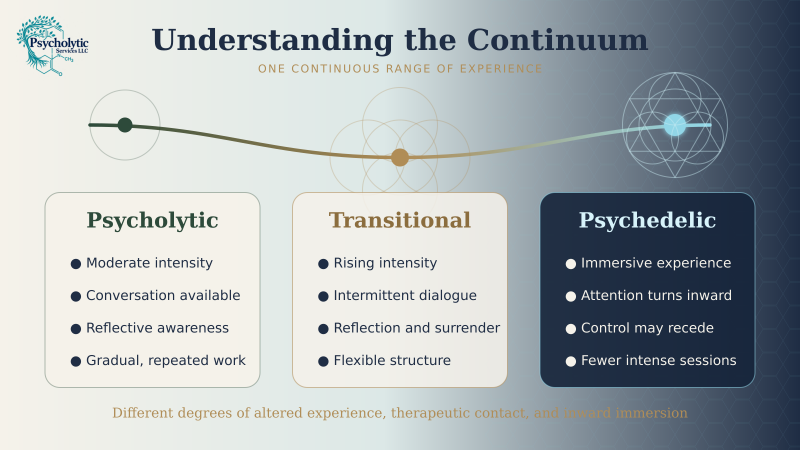
Understanding this continuum allows medicine-assisted psychotherapy to become more individualized. Rather than asking whether psycholytic or psychedelic therapy is better, we can ask a more useful question:
What degree of altered experience will allow this person to access meaningful material while remaining sufficiently supported to integrate what emerges?
Alan Romano, LCSW
Psycholytic Services LLC
Author • Educator • Psychotherapist
Founder of Functional Systems Regulation Theory™
This article is educational and does not constitute medical advice or an offer of treatment with a controlled substance.
Add comment
Comments