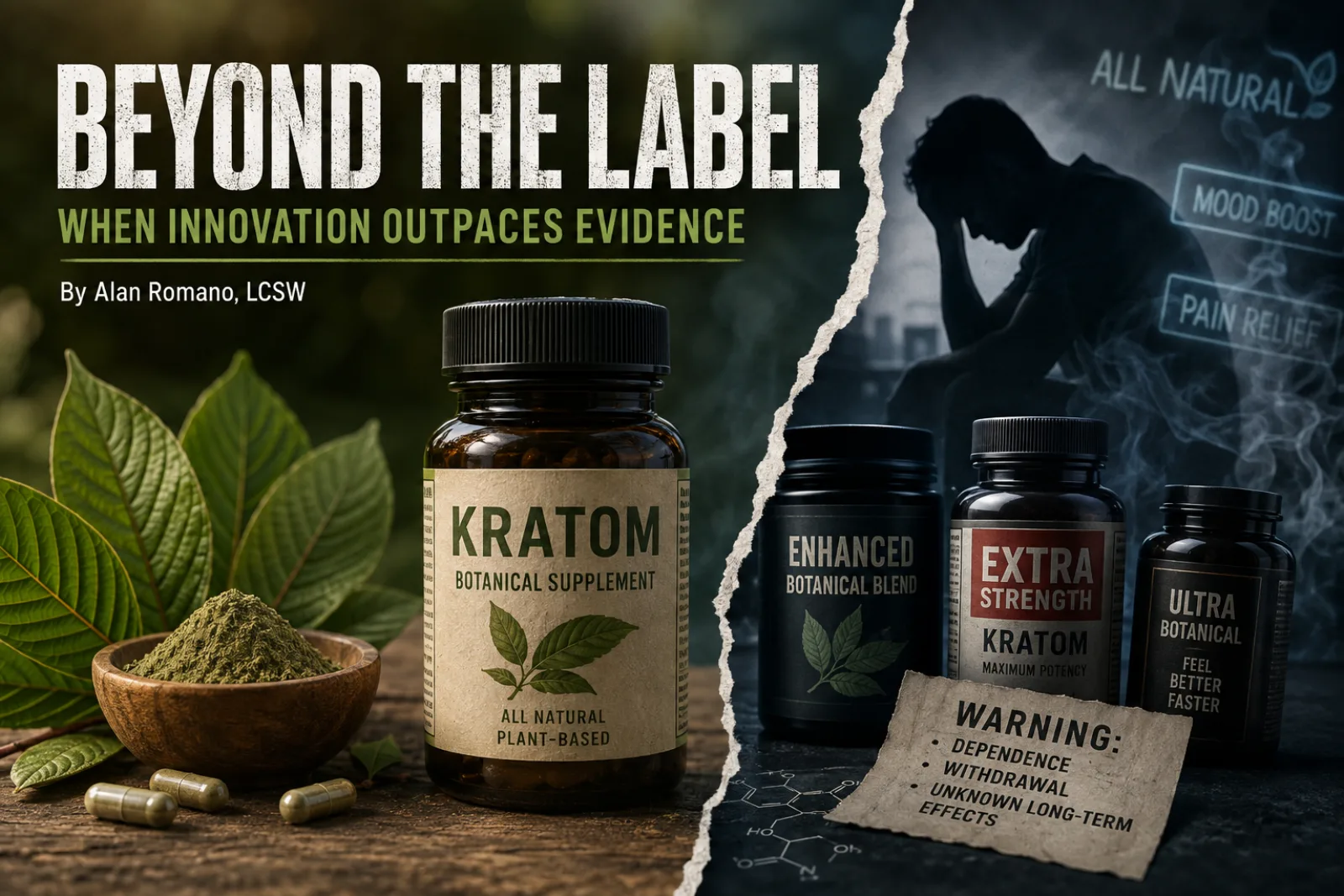
More than a century ago, Americans were promised miracle cures by charismatic salesmen traveling from town to town with bottles of "snake oil." They claimed their products could relieve pain, restore energy, cure addiction, calm anxiety, and improve nearly every illness imaginable. Their labels looked convincing. Their testimonials sounded genuine. Their products were often marketed as natural, proprietary, or based on secret formulas.
Eventually, the public realized something was wrong.
People were becoming sick. Some were being harmed. Others were spending money on products that delivered little more than false hope. Public outrage over misleading health claims and unsafe products helped drive passage of the Pure Food and Drugs Act of 1906, legislation that laid the foundation for what would eventually become the U.S. Food and Drug Administration.
The central idea was simple.
People deserve to know what they are putting into their bodies.
More than one hundred years later, the horse-drawn wagons have disappeared. The marketing has not.
Today's products arrive through social media advertisements, influencer endorsements, smoke shops, convenience stores, gas stations, and online retailers. The language has changed from "miracle cure" to "plant-based," "natural," "wellness," "herbal," and "proprietary botanical blend." The promise, however, feels remarkably familiar.
As a therapist working with individuals recovering from opioid dependence, alcohol use disorder, and other addictive disorders, I have begun noticing an increasingly concerning trend. More people are reporting significant withdrawal symptoms after using products marketed as herbal supplements or enhanced botanical blends.
Most never intended to misuse drugs. They were looking for pain relief, more energy, reduced anxiety, improved focus, or a way to transition away from opioids. Instead, some describe finding themselves physically dependent on products they believed were simply concentrated plants.
That raises a question we should all be asking:
Are people becoming dependent on the herbs listed on the label, or are they becoming dependent on something else entirely?
The Problem With Assuming "Natural" Means Safe
Plants are powerful. Morphine comes from the opium poppy. Digoxin comes from foxglove. Quinine comes from cinchona bark. Aspirin traces its origins to willow bark.
Nature has given us some of the most effective medicines ever discovered.
There is an important distinction between a traditionally used medicinal plant and a commercially manufactured product containing multiple concentrated extracts, proprietary formulations, flavoring agents, synthetic additives, or chemically modified compounds. Although both may be described as "botanical," they should not automatically be considered equivalent.
Consumers often assume that because something is sold legally on a store shelf, it has undergone rigorous testing for safety and effectiveness.
That assumption is understandable. It is also frequently incorrect.
Unlike prescription medications, dietary supplements generally are not required to demonstrate effectiveness before reaching the marketplace. While manufacturers are responsible for complying with labeling and safety laws, many products enter the market without the extensive pre-market clinical testing consumers often assume has occurred.
Scientific discovery moves carefully. Marketing often does not. The translation of scientific discoveries into routine clinical understanding and practice has long been recognized as a gradual process, often requiring years of research, replication, implementation, and ongoing evaluation before evidence is fully integrated into healthcare. In rapidly evolving consumer markets, however, new products and formulations can emerge far faster than that process can keep pace. That gap has created an environment where product innovation frequently outpaces scientific investigation.
A Clinical Blind Spot
One of the most striking patterns I have noticed in clinical practice is not simply that people are using these products. It is that many of them do not consider them to be drugs at all.
When I conduct a substance use assessment, I routinely ask clients whether they use alcohol or other drugs.
Over the last several years, I have lost count of how many times this conversation has occurred.
"No. I don't use drugs or drink." Then, a few minutes later, they casually add, "Well...I do take kratom." As we continue exploring their use, the story often becomes much more revealing.
Many use multiple times throughout the day. Some organize their schedules around when they can take their next dose. Others describe anxiety when they are running low, withdrawal symptoms when they try to stop, and repeated unsuccessful attempts to cut back.
By the end of the conversation, some describe spending $50 to $200 every day, planning their day around dosing, and becoming physically ill when they stop.
Yet many still do not identify themselves as using a psychoactive substance. The disconnect is remarkable. In many cases, they genuinely believe they are taking an herbal supplement rather than a product that interacts with the same opioid receptors involved in pain relief, reward, tolerance, and physical dependence.
That misunderstanding has consequences that extend well beyond addiction. When people do not recognize that a product interacts with the opioid system, they may never mention it to their physician before surgery, while starting a new medication, during pregnancy, or when seeking treatment for a substance use disorder. They may omit it from medication lists because they simply do not view it as relevant medical information. Unfortunately, what a patient doesn't report is often information a healthcare provider needs in order to make safe clinical decisions.
This is not a criticism of the people using these products. Most are making decisions based on the information they have been given.
If a product is marketed as "natural," displayed next to dietary supplements, and sold legally without a prescription, it is understandable why many consumers assume it carries little risk of dependence.
The challenge for clinicians is that if we only ask, "Do you use drugs or alcohol?" we may completely miss an important part of the clinical picture.
Perhaps the better question is not simply, "Do you use drugs or alcohol?" but also, "What supplements do you take?" "Do you use kratom or any enhanced botanical products?" and "Have you ever felt sick, anxious, restless, or unable to function when you stopped taking one?"
Those questions may reveal information that a traditional substance use history never uncovers. As clinicians, we cannot identify emerging trends if we never ask about them. And if patients do not recognize these products as substances capable of producing physical dependence, many will never think to mention them at all.
This discussion extends beyond any single product. At its core, it is about health literacy and informed decision-making. Every day, consumers make choices about supplements, medications, and wellness products based on labels, advertising, online reviews, social media, and recommendations from friends or family. When those sources fail to accurately communicate how a product works or the risks it may carry, people cannot make truly informed decisions. Informed consent is not simply a principle of medicine. It is also a principle of consumer protection. People deserve to understand what they are putting into their bodies before they decide whether the potential benefits outweigh the risks.
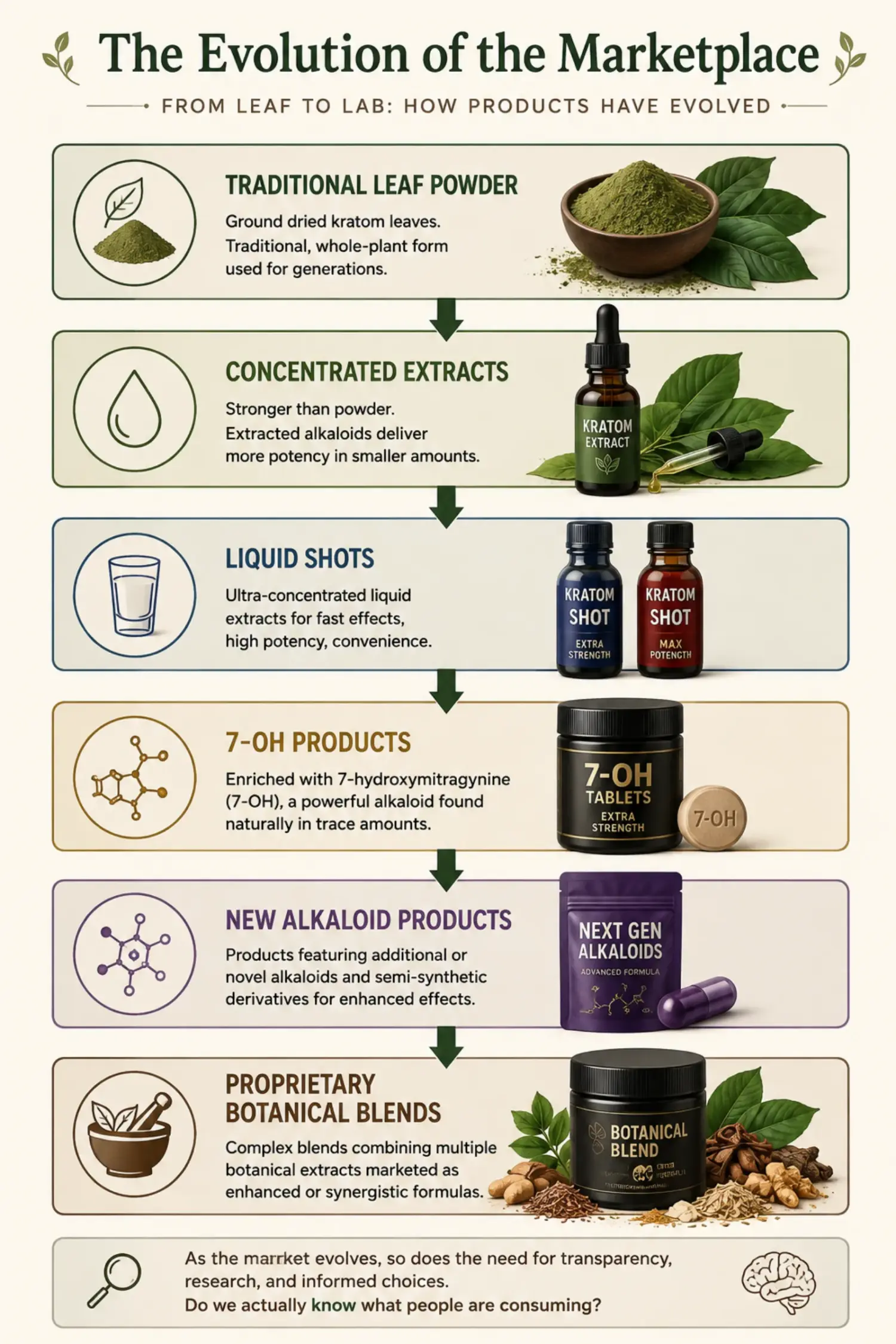
The Evolution of the Kratom Marketplace
For decades, most people who used kratom consumed it as a traditional leaf powder. Then the market began to change as concentrated liquid extracts became widely available. While concerns about dependence and withdrawal certainly existed, consumers generally knew they were purchasing the ground leaf of Mitragyna speciosa.
Manufacturers began producing concentrated liquid extracts that delivered substantially higher amounts of kratom alkaloids than traditional leaf powder. These products quickly gained popularity because they were smaller, easier to consume, and often far more potent than the leaf itself.
That evolution was not driven solely by manufacturers. It was also driven by consumer demand. People generally prefer products that are more convenient, easier to carry, faster to use, more consistent from dose to dose, and, for some, capable of producing stronger or more predictable effects. As consumers rewarded those characteristics, companies responded by developing increasingly concentrated and increasingly sophisticated formulations. That pattern is not unique to kratom. It reflects a broader reality of consumer markets: innovation follows demand.
Rather than simply concentrating the natural plant, manufacturers began marketing products enriched with 7-hydroxymitragynine (7-OH), an alkaloid that occurs naturally in kratom but only in trace amounts within the leaf. As increasingly concentrated 7-OH products entered the marketplace, consumers were no longer purchasing a traditional botanical preparation. They were purchasing an entirely new category of product with a substantially different pharmacological profile.
The marketplace has continued to evolve. Some manufacturers have begun promoting products containing other kratom-derived alkaloids or semi-synthetic derivatives, while others have shifted toward proprietary botanical formulations that combine multiple herbs, concentrated extracts, or novel ingredient blends.
As regulators have increased scrutiny of concentrated 7-OH products, many consumers have noticed yet another shift. New formulations are appearing that prominently feature other botanicals, including ingredients such as cat's claw, alongside proprietary blends whose complete pharmacology remains unclear.
By the time many people realize the marketplace has changed, the products they are using often bear little resemblance to the traditional plant from which they originated.
This does not mean cat's claw is causing dependence. There is currently no strong scientific evidence that cat's claw itself produces opioid-like physical dependence or a recognized withdrawal syndrome.
Rather, cat's claw illustrates a much larger issue. The marketplace has evolved faster than our scientific understanding, leaving consumers and clinicians alike trying to understand products that often differ substantially from the traditional plants from which they originated.
A bottle may prominently advertise one familiar herb while containing numerous concentrated botanical extracts or proprietary ingredients that receive far less attention than the name on the front label.
Consumers are often left without a clear understanding of which ingredients are responsible for the desired effects, which may contribute to tolerance or withdrawal, or how multiple botanical compounds interact within the body. In many cases, the available scientific evidence is simply not sufficient to answer those questions with confidence, leaving both consumers and healthcare professionals navigating considerable uncertainty.
Those are questions that should be answered by research, not by trial and error in the lives of consumers.
Every time one product category receives increased regulatory scrutiny or public attention, the marketplace creates a financial incentive to develop the next product that falls outside the existing conversation. This pattern is not unique to kratom. Similar cycles have occurred throughout the history of tobacco, vaping products, synthetic cannabinoids, designer stimulants, and numerous other emerging markets. The products change. The marketing evolves. But the pattern remains remarkably consistent, raising important questions.
We Have Seen This Before
Although the products themselves have changed, the pattern is remarkably familiar. Over the past two decades, the United States has repeatedly watched new psychoactive substances enter the marketplace faster than science, medicine, and regulation could fully understand them.
Synthetic cannabinoids such as Spice and K2 were initially marketed as legal herbal incense before clinicians began reporting severe psychiatric symptoms, cardiovascular complications, and unpredictable toxicity. Bath salts, marketed as harmless alternatives to illicit stimulants, quickly became associated with emergency department visits across the country. More recently, products containing delta-8 THC, phenibut, tianeptine, nitrous oxide, and a variety of other novel compounds have appeared in convenience stores, smoke shops, vape stores, and online marketplaces, often existing in a gray area between dietary supplements, consumer products, and regulated pharmaceuticals.
The point is not that these substances are all pharmacologically equivalent. They are not. Each acts through different neurochemical pathways, carries different risks, and produces different clinical effects. The common thread is something much larger. Time and again, commercial innovation has outpaced scientific investigation, leaving clinicians to recognize emerging problems only after patients begin arriving with unexpected symptoms, adverse effects, dependence, or withdrawal.
Kratom and the rapidly evolving marketplace surrounding concentrated extracts and proprietary botanical formulations may represent the latest chapter in that broader story.
Whether these products ultimately prove to be safer or riskier than other emerging substances remains an open scientific question. What history teaches us, however, is that waiting until we fully understand a new product before beginning to study it is often waiting far too long.
It is also important to recognize that not every product in this rapidly evolving marketplace poses the same level of risk, and many consumers report meaningful benefits. The challenge is that we currently lack enough independent evidence to reliably distinguish lower-risk products from higher-risk formulations. That uncertainty is precisely why careful scientific investigation is so important.
If we have learned anything from previous waves of emerging psychoactive products, it is that curiosity should begin before certainty. By the time certainty arrives, thousands of people may have already participated in the experiment.
What Clinicians Are Beginning to See
Across addiction treatment settings, clinicians are increasingly hearing similar stories from patients who have become dependent on products purchased legally from smoke shops, vape stores, gas stations, wellness stores, and online retailers. Individuals commonly describe experiencing anxiety, insomnia, sweating, restlessness, muscle aches, gastrointestinal distress, restless legs, and intense cravings when they attempt to stop using these products. Some report that the withdrawal they experience feels similar to what they have previously experienced when discontinuing opioids or traditional kratom products.
Whether these symptoms are related to concentrated kratom alkaloids, combinations of botanical extracts, undisclosed
psychoactive ingredients, contaminants, or interactions among multiple compounds remains largely unknown. What is becoming increasingly difficult to ignore, however, is that clinicians are encountering these cases with greater frequency, while the scientific literature is only beginning to explore the mechanisms behind them.
The Largest Uncontrolled Experiment Nobody Is Talking About
Every day, thousands of people purchase products that have never undergone the level of scientific evaluation we typically expect from prescription medications. They combine these products with other supplements, prescription medications, and varying doses based largely on personal experience rather than scientific guidance. Some report meaningful benefits, others develop tolerance or withdrawal, and many experience no obvious problems at all. At this point, we simply do not know why those experiences differ so dramatically.
In many ways, society is conducting a massive uncontrolled human experiment. Unlike a clinical trial, there are no standardized doses, carefully selected participants, or systematic follow-up.
Instead, people are independently experimenting with increasingly complex botanical formulations while scientific understanding struggles to keep pace.
Much of what we learn comes only after something goes wrong, when a person arrives in an emergency department, enters addiction treatment, or casually tells a healthcare provider, "Well...I do take kratom." By then, the experiment has already taken place. The challenge is not simply that we lack definitive answers. It is that we are only beginning to recognize the questions we should have been asking all along.
The Regulatory Gap
The FDA was created because Americans demanded honesty in medicine. Its mission has always balanced public safety with access to legitimate products.
Today's supplement marketplace, however, differs dramatically from the marketplace lawmakers envisioned in 1906. Ingredients can be sourced globally, products can be reformulated in weeks, and marketing campaigns can reach millions of consumers almost overnight.
The speed of innovation has fundamentally changed. Products that once evolved over decades can now change in a matter of months, leaving researchers and regulators trying to evaluate one generation of products while the next has already entered the marketplace. Online retailers can introduce entirely new formulations before independent researchers have even begun studying the previous generation.
This is not necessarily a failure of science, nor is it necessarily a failure of any single regulatory agency. Rather, it reflects the reality that our regulatory systems, scientific institutions, and public health infrastructure were not originally designed for a marketplace capable of evolving at this pace.
When innovation consistently outpaces evidence, consumers often become the first large-scale participants in understanding the benefits, risks, and unintended consequences of new products. That should concern all of us.
How Would We Even Know?
One of the most overlooked questions in this discussion is also the most important. If enhanced botanical products are producing physical dependence, how would we know? Most physicians don't routinely ask patients whether they're taking proprietary herbal blends purchased at smoke shops or online.
Many patients don't consider these products to be drugs. Instead, they think of them as supplements, wellness products, alternatives to pharmaceutical medications, or simply natural remedies.
As a result, these products often go unreported during medical evaluations.
When someone presents to an emergency department with anxiety, insomnia, sweating, nausea, tremors, elevated heart rate, or severe restlessness after stopping one of these products, the connection may never be made. Symptoms may be attributed to generalized anxiety, panic disorder, opioid withdrawal, stimulant use, viral illness, or an unknown cause.
If clinicians are not routinely asking about these products, it is not surprising that we know so little about them. When patients do not mention their use, those experiences are never documented. Without consistent documentation, researchers struggle to recognize emerging patterns, making it difficult to design meaningful studies or understand the scope of the problem. In the absence of reliable scientific evidence, regulatory agencies are often left responding to problems only after they have become widespread rather than identifying them early. History suggests that we have seen this cycle before.
The Label May Not Tell the Whole Story
Imagine purchasing a bottle that advertises one or two familiar herbs across the front label. Cat's claw, Kava, Akuamma, or Corydalis.
Perhaps a few vitamins or amino acids. To the average consumer, those ingredients appear familiar and relatively benign. What often receives far less attention is everything else. Some products contain multiple concentrated botanical extracts. Others contain proprietary blends that do not disclose the precise amount of each ingredient.
Some include naturally occurring alkaloids concentrated far beyond what would typically be encountered in traditional herbal preparations. Others may contain ingredients whose pharmacology has never been studied in combination. Even when every ingredient is listed accurately, consumers are still left asking important questions.
Consumers are often left without a clear understanding of which ingredients are producing the desired effects, which may contribute to tolerance or withdrawal, or how multiple botanical compounds interact within the body. In many cases, the available scientific evidence is simply not sufficient to answer those questions with confidence, leaving both consumers and clinicians navigating considerable uncertainty.
That uncertainty should not automatically be interpreted as evidence of danger. But neither should it be interpreted as evidence of safety. Ignorance is not reassurance. It is simply an unanswered scientific question.
The Need for Better Science
This article is not an argument against herbal medicine. Quite the opposite. Many traditional medicinal plants have survived centuries of use because they possess genuine therapeutic properties. Some have gone on to become prescription medications.
Others continue to play an important role in cultures around the world. The problem is not the existence of medicinal plants. The problem is the growing gap between traditional herbal medicine and commercially engineered botanical products.
Those are fundamentally different categories, and they should not automatically be evaluated using the same assumptions.
Traditional herbal medicine evolved over generations within cultural systems that understood preparation methods, dosing, indications, and risks. Modern commercial products are often designed for maximum consumer appeal in an intensely competitive marketplace.
That difference deserves far more scientific attention than it has received. We need independent laboratories analyzing commercially available products. We need toxicologists studying withdrawal syndromes. We need pharmacologists examining interactions between concentrated botanical alkaloids. We need addiction researchers documenting emerging patterns before they become established epidemics.
Most importantly, we need transparency. Transparency is not the same as prohibition. Consumers can only make informed choices when they have accurate information about what a product contains and what is known, and not yet known, about its effects.
Consumers should not have to wonder what is actually inside a bottle they purchased legally. Knowledge has always been the foundation of public health. Without transparency, meaningful informed consent becomes impossible.
Clinicians should begin asking about these products during routine substance use assessments. Researchers should prioritize studying commercially available formulations rather than only traditional plant preparations. Regulators should continue evaluating how rapidly evolving botanical products fit within existing oversight frameworks. Manufacturers should invest in transparency and independent testing. Consumers should ask the same question every healthcare professional asks: What exactly am I putting into my body?
A Call to Curiosity
Perhaps these products will ultimately prove to be safer than some fear. Perhaps future research will demonstrate that many concerns are overstated. Science should remain open to either possibility.
But science cannot answer questions that no one is asking. As clinicians, we have an opportunity, and a responsibility, to pay attention before isolated stories become widespread patterns.
As researchers, we have a responsibility to investigate rather than assume. As consumers, we have a right to know what we are putting into our bodies.
The goal is not fear, it is transparency. The goal is making sure that, more than a century after the snake oil era inspired the creation of the FDA, we do not repeat the same mistakes under more sophisticated packaging.
More than one hundred years ago, the American public demanded honesty in medicine because they grew tired of buying bottles whose contents they did not understand.
Today, we face a remarkably similar challenge, although it appears in a very different form. The labels are cleaner, the websites are more sophisticated, the marketing is more persuasive, and the products can be delivered to our doorsteps overnight. While the marketplace has evolved dramatically since the days of the traveling snake oil salesman, the fundamental question remains the same: do consumers truly understand what they are buying and the potential risks that accompany it?
History rarely repeats itself exactly, but it often updates its packaging.
The central idea, however, has never changed.
People deserve to know what they are putting into their bodies.
Add comment
Comments